
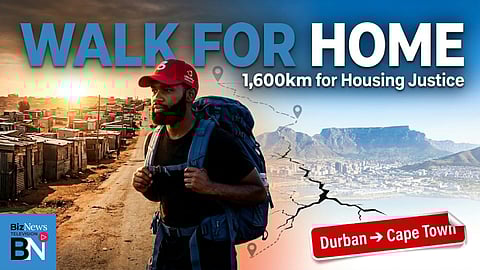
KZN architect walks from DBN to CTN to fund AI fix for SA’s 2.5 million housing backlog
South Africa’s housing backlog exceeds 2.5 million units, with more than 4,000 informal settlements straining municipalities for serviced land. KwaMashu-born architect Wandile Mthiyane, who grew up in a mud-brick shack, is developing Ubuntu Home – an AI platform designed to provide people with land, services and AI tools so they can design and build their own homes. In a Biznews interview, Mthiyane recalls his aunt receiving a Mandela-era housing list number but recently dying still in the same shack. He says the crisis needs decentralised solutions, not more top-down contractors. The Obama fellow and future Harvard student launched the Walk for Home to raise R3 million to develop and scale the platform. He reports receiving many offers of accommodation, financial assistance, and support within days. – Linda van Tilburg
Sign up for your early morning brew of the BizNews Insider to keep you up to speed with the content that matters. The newsletter will land in your inbox every morning on weekdays. Register here.
Support South Africa's bastion of independent journalism, offering balanced insights on investments, business, and the political economy, by joining BizNews Premium. Register here.
If you prefer WhatsApp for updates, sign up to the BizNews channel here.
Watch here
Listen here
Edited transcript of the interview
Linda van Tilburg (00:00)
Wandile Mthiyane is a social-impact architect who grew up in KwaMashu in KwaZulu-Natal. He has since been recognised internationally for his mission to undo apartheid architecture. And he has begun a 1,600-kilometre Walk for Home, a journey from Durban to Cape Town to speak to local communities about how they experience housing.
Well, let's start at the beginning. I've read up about you and how did you go from growing up in a township to studying architecture? You were invited to the UN, you became an Obama fellow, and you are taking now this mission to rethink apartheid-era housing. So how did that all happen?
Wandile Mthiyane (00:52)
You know, when you put it that way, I also am amazed at how I got here. But I think it really starts with growing up in a township in KwaMashu as well as Mawode, in a couple of informal settlements or shanty towns in Durban. When I was six, I grew up with my aunt, and she lived in this shack in Inanda in Mawode. I remember a government official coming into our home and writing a number on the door and that was the number she was on the list for the redevelopment programme, which Nelson Mandela started to help people gain housing as part of reparations for apartheid.
And I got a call just about four weeks ago that my aunt had passed. And the first thing I thought about was the fact that she died still waiting for that house in that same migrant home and I became an architect to solve that problem and that propelled me to study architecture in Michigan, to start designing homes for people that have work lives. So it's a home with commercial space for families in shanty towns to be able to financially sustain themselves. And I'm now building an AI app to help people like my aunt to not just wait or die waiting really, to be able to start designing, building and financing their own homes.
Linda van Tilburg (02:19)
So architecture sounds like such an unusual career for somebody who grew up like you did.
Wandile Mthiyane (02:26)
Yeah, 100 percent. I think when I was growing up in informal settlements and townships in Durban, I didn't know what an architect was. Because everyone was an architect in my community. When a new member came in, we would all come together, scrap metal, leftover material, and we'll help them build. So the fact that I'm now an architect and just got accepted to Harvard University for a master's in design engineering because of my work I'm doing within AI to spread sort of architecture, it's surreal, but it's also a sign that when you truly care about a problem and you start working towards it and eventually people will catch on with you and it will open a lot of doors.
Linda van Tilburg (03:11)
Why are you undertaking this walk or what are you hoping to learn along the way? Because you're going to pass through some of the poorest parts of the country in the Eastern Cape and then into the Cape Flats.
Wandile Mthiyane (03:22)
A hundred percent. Yeah. I'm definitely still in the fun part of the journey as I am in KwaZulu-Natal, still closer to home, close to the beach, et cetera. But the idea is as I'm building this platform and as I'm going to Harvard to accelerate this work, I want to intimately understand what the housing challenge is. I want to learn from the communities. I believe no one knows best where they're to live than the people who actually live there. Right. So I want to co-build this solution and then go to Harvard to get those AI skills and the network and the capital to be able to scale it in South Africa. So in part, I'm raising awareness on this very real challenge of the lack of affordable housing and the affordable housing crisis in South Africa. In Durban, it looks like the lack of RDPs. In Cape Town, it looks like people being priced out of their apartments due to digital nomads. How do we start creating policy, how do you start creating economic opportunities for us to solve this problem. That's one. The other part is I am raising funds. I'm raising R3 million rands so that I am able to sort of develop this platform at Harvard, which pays towards my master's in design engineering.
Linda van Tilburg (04:36)
Okay, well, you talked about your aunt that had this number on the door and never got the home that she absolutely wished for. So you've said a little bit about how scarce housing is in South Africa. Can you just elaborate on that?
Wandile Mthiyane (04:53)
100 percent. I think it's part policy, part political will and part execution. So there's a policy that came up, I think around 2008, it's called the Enhanced People’s Housing Policy. And what it does is it decentralises how affordable housing is distributed by the government. So, instead of hiring one contractor to build a thousand homes where there's a lot of bottlenecks, potential corruption. And if anything happens to that contractor, the whole housing project is stalled. Right? So what you do is you actually build out stands and give people stands. What it does is it creates a sense of urgency and people get to design and build their own homes. Give them land, you give them stands, access to water and electricity. And similar to how, you know, social service grants work, you then give them money to be able to build their own homes, the same budget you would have given to that other contractor.
And the argument can't be that you don't have the infrastructure because you already have so much social grants. And the same way you would have come and accessed different levels of the house, you come and access different levels individually.
What this does is it creates job opportunities when South Africa has such high unemployment. It creates ingenuity and people are able to design and build their own homes.
So platforms like the Ubuntu Home that I'm building, enables people to design their own dignified homes and also creates jobs within the community. And that's really what I'm advocating for. The problem is in execution.
The policy exists, right? The implementation doesn't. You know what I mean? So people are doing things the same lazy way, right? Like one big general contractor, one big general developer, and clearly, it's not working, right? We've got 2.5 million backlogs. Now, let's cut some slack for the government. Because this is not a complaint walk. It's a solution walk. When they started the RDP programme, I think they had like 2 million homes or something like that. They've far exceeded the goal of that particular programme, right? But, you know, obviously the goal was very small compared to the actual problem within South Africa. So there's that part. So there has to be an adjustment to their strategy, to the execution and to the original framework.
Linda van Tilburg (07:24)
So if you're talking about undoing apartheid architecture, what does it mean in practice? So, who builds it? Who pays for it? Is this government driven, private sector driven or something else?
Wandile Mthiyane (07:37)
What does apartheid architecture mean? Because I think we, you know, we throw a lot of these big words, decolonisation, apartheid architecture. But what it means is that we did not come to this housing crisis by accident. Right. It is by design where you had informal settlements and townships built for black people. There was curfew.
It's very similar to the word ghetto that goes back to the 1500s to Jewish communities in Europe where there was a curfew from 6 a.m. to 6 p.m. etc. So now we have a whole population that was devoid of economic opportunities, devoid of housing, now coming into the fold where they are now eligible to get housing. So now there isn't enough infrastructure because the cities were not built for them. They were only built for 10 percent of South Africans. The others were labour.
So all of those things is what sort of decolonisation looks like. Okay. How do we start building infrastructures in tribal land? How do we start building infrastructure in townships and how do we start equipping historically disenfranchised people to be able to build their own homes?
Linda van Tilburg (08:50)
So there's a lot of emphasis that the people have to build their own homes and often when they design, they're not designed for what people want. Is that what you have found?
Wandile Mthiyane (09:00)
100 percent. I think waiting for the government to change things has not worked for us. We're 30 years into democracy and we're 2.5 million people backlogged from housing and high unemployment, etc. So my plea with the government is to work with us young people because we want to be the change we want to see. We're not saying create a new policy. We're asking them to implement the policy they've already passed.
And, you know, platforms like Ubuntu Home that uses AI to help scale the government implementation of housing are things that are very important. And I can't imagine the ingenuity that's going to come as young people are able to sort of then participate in the economy of building homes for their own families and for their community, et cetera. And we're just asking them to unlock the economy as well as unlock the procurement to be decentralised and bottom-up versus top-down.
Linda van Tilburg (10:03)
Okay, well tell us more about this platform that you have. How far down the road are you and if you have an app, what do you do with it?
Wandile Mthiyane (10:11)
That's a really good question. So what Ubuntu Home does is when you are trying to build a home, you would say, Hey, I want a two-bedroom home that is of this style, like this, et cetera. And you say, this is my budget. This is where I live. You drop a pin, similar to how you drop a pin on WhatsApp. So, what it does then is it uses geotech to understand some of the soil conditions in the area. And then it's able to then design a floor plan as well as a recommended foundation structure. You know, especially in KZN there are very flood-prone places. So it's very important for you to be able to build up to a standard. And then what it does, and it then connects you to local builders, local draftsmen who can actually help you get your plans passed by the city and you can start building instead of waiting the 25 years as my aunt did. I believe that had she had this platform in her hands over 10 years ago, she would have been able to build her home. And that's what this Walk for Home is about, right? It's about instead of waiting; we're taking that walk forward to be the change that we want to see.
Linda van Tilburg (11:16)
So you said you want to raise money with this walk. Do you have something like BackaBuddy or how are you raising funds with your walk?
Wandile Mthiyane (11:24)
So people can support our work on our GoFundMe platform. It's in our social media, whether you're on Instagram or on Facebook or on TikTok, WandileUbuntu. You can sponsor a kilometre that I'm walking for R2,500 rands, $150. I don't know how much it is in pounds. You can sponsor a kilometre.
Or you can host me for a night if you live around the way or you know someone that lives around the way, or you can come walk with me a mile or a kilometre. So yeah, we would love to have that. It's been beautiful to kind of meet people around the way and ask them what does home mean to you?
Linda van Tilburg (12:07)
You have just started, but what response have you had so far?
Wandile Mthiyane (12:11)
Today I met a lady. I walk in the morning to sort of beat the heat and she said home for her means a safe space where she feels warm with her loved ones. And that resonated with me. And I believe that the minimum requirement for one to have a dream is a dignified place to call home. And that's what I want everyone to have access to.
Actually, today I was walking on the road going towards Scottburgh and this lady was waiting for me outside and just like an older lady, she came up to me, and you know, she said, I heard about what you're doing. I think it's incredible and I want to support you. And then she took out R30, and she gave it to me. And that's been so much. And it's so special. At that moment, she prayed for me. And, you know, it could be her last R30. And because she believes in young people solving the problem within our community so much that she came up. So that touched my heart and refreshed me and replenished me and I'm excited to keep going for people like her.
Linda van Tilburg (13:29)
Well, and after the walk are you heading to Harvard?
Wandile Mthiyane (13:32)
Yes, after the walk, I'll be in Boston for a little bit at Harvard as of August. So, if you're that side as well, yeah, let's hang out. No, I just wanted to add that I think it's important to mention in this interview that you interviewed Nelson Mandela and now you're interviewing me.
Linda van Tilburg (13:52)
That's a card I'm going to pull out for the rest of my life.
Wandile Mthiyane (13:56)
Yeah, yeah, yeah, yeah, yeah, as you should.
Linda van Tilburg (13:59)
Well, Wandile, good luck with this walk and I'm going to follow you as you go along, and we can talk at the end and see how it went. And good luck with this platform. It sounds like a wonderful idea.
Wandile Mthiyane (14:10)
Amazing, amazing. And people can follow me at WandileUbuntu across all social media platforms. I'd love to hear what home means to you and yeah, support and join the journey. Be the change that you want to see.
