
Payroll tech company Allwage tackles wage pain points: Ghost workers, fraud – loan sharks next
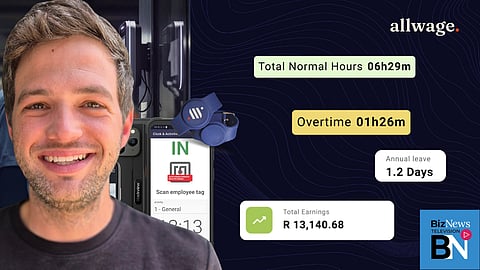
In South Africa, countless businesses still rely on outdated systems—like paper timesheets and manual tracking—for wage management. Yet millions of workers carry smartphones in their pockets, unlocking a prime opportunity for innovation. Enter Allwage: harnessing mobile tech to streamline payroll, boost accountability, and revolutionise wage-earner oversight. Co-founder Cilliers Geldenhuys explains how they rebranded from Agrigistics to Allwage amid expansion into construction and manufacturing—beyond their agricultural roots—now serving 40,000–50,000 workers, with plans to double that next year. He also reveals ambitions to tackle these workers' financial woes, offering fair alternatives to loan sharks who prey on low-paid earners.
Sign up for your early morning brew of the BizNews Insider to keep you up to speed with the content that matters. The newsletter will land in your inbox at 5:30am weekdays. Register here.
Support South Africa’s bastion of independent journalism, offering balanced insights on investments, business, and the political economy, by joining BizNews Premium. Register here.
If you prefer WhatsApp for updates, sign up to the BizNews channel here.
Watch here
Listen here
Edited transcript of the interview
00:00:00 Linda van Tilburg
In South Africa, millions of wage workers still rely on paper timesheets, manual payrolls, and opaque systems. This situation can be frustrating for both employers and employees. My guest today recognized this gap and built a solution. Alongside two fellow engineers, he launched a company called Agrigistics. High demand soon pushed the business beyond its agricultural roots, leading to a rebranding. Today, it's known as All Wage. Joining me in the studio is co-founder Cilliers Geldenhuys.
00:00:36 Linda van Tilburg
Can you start by taking us back to the beginning? What problem did you and your fellow engineers set out to solve when you started Agrigistics?
00:00:47 Cilliers Geldenhuys
We began in the mining industry, monitoring machine operations and productivity. This transitioned into the agricultural sector, where we focused on employee productivity. Our primary goal was to track how many employees participated in harvesting and packing to help incentivize them better. From there, we expanded into the employee management space where we are now.
00:01:20 Linda van Tilburg
When demand began coming from outside agriculture, was that the main driver behind the rebranding?
00:01:28 Cilliers Geldenhuys
Agriculture remains our main channel, but we've started selling significantly to the construction, mining, and manufacturing industries as well. The name just didn't resonate with those sectors. We needed to rebrand to better serve any wage-intensive company in South Africa.
00:01:54 Linda van Tilburg
What does your platform offer?
00:01:56 Cilliers Geldenhuys
We provide an employment management ecosystem built on four main pillars: time and attendance, payroll, document management, and employee communications. We help companies manage their employees digitally and accurately, addressing many issues that arise, particularly with wage earners. Traditional integrations between separate systems don't suffice for large companies with numerous complexities.
00:02:39 Linda van Tilburg
WhatsApp integration is unusual for a payroll system. Why did you choose that route?
00:02:45 Cilliers Geldenhuys
WhatsApp has made it easy to integrate different products, and it made sense because most employees use WhatsApp. It allows us to communicate work hours, leave details, and enable leave applications seamlessly. This also reduces administrative burdens for employers. In some cases, employees are in remote locations where traditional communication methods may fail, making WhatsApp a viable solution.
00:03:28 Linda van Tilburg
South Africa's labor laws are notoriously complex. How do you simplify compliance for businesses that lack large HR departments?
00:03:39 Cilliers Geldenhuys
Compliance factors remain consistent across payroll companies; staying compliant with regulations is essential. We’ve recruited specialists who guide our product team to adapt to any changes in the law. While all payroll companies ensure compliance, we offer added value in our ecosystem. For example, managing contracts digitally streamlines the process, eliminating the need for physical paperwork.
00:04:44 Linda van Tilburg
You've expanded beyond agriculture. Where do you see All Wage going next?
00:04:51 Cilliers Geldenhuys
We aim to dominate sectors like construction and agriculture within South Africa. No one has truly taken the lead in these industries yet. Beyond that, our goal is to target companies employing wage earners across Africa and other developing countries, which often face similar challenges with high volumes of wage staff.
00:05:30 Linda van Tilburg
So you're not only in South Africa; you're also in Africa?
00:05:33 Cilliers Geldenhuys
Currently, we're mainly in South Africa, with a few clients in Namibia and Mozambique. Global expansion will be our next step.
00:05:48 Linda van Tilburg
Tell us more about the founders. Who are you?
00:05:54 Cilliers Geldenhuys
Yes, I am an engineer. My co-founders, Luke Kroon and Johan Ferreira, are computer engineers. We met at university while studying and living in the same residence. After graduating, we worked on projects in the mining industry before deciding to challenge ourselves and create something meaningful.
00:06:34 Linda van Tilburg
What feedback do you receive from both employees and employers about your platform?
00:06:41 Cilliers Geldenhuys
From day one, our focus has been on adding value for employers, but we've just begun enhancing the value for employees as well. We're excited about this chapter. Employees want fair treatment and accurate wage monitoring; generally, around 98% of the workforce is satisfied. Those who are unhappy typically attempt to exploit the system—those are the individuals you don't want in your organization. Employers consistently express their satisfaction when we deliver value.
00:07:26 Linda van Tilburg
Well, in South Africa, you read about the issues of ghost workers, and of course, there could always be disputes about hours. So how do you bring transparency and trust into wage-heavy industries?
00:07:39 Cilliers Geldenhuys
So, what we like to do is ask the clients before they sign up what problems they obviously have regarding ghost workers and accurate hours, as well as overtime. Then, once we’ve implemented the system, we go back to those questions. We ask them if they had ghost workers before and whether they see any problems going forward. For us, of course, that answer has to be no. We also provide them with explanations and examples beforehand. We encourage them to share contact details with our current clients so they can chat with them and find out what their experiences have been. Usually, that helps a lot to revisit those questions once we've implemented the system to see what the actual changes were. From there, they also know that there are no ghost workers because we ensure accurate hours. We add checks into the system for those problems, and we usually walk them through it to say this is the reason why you can’t have ghost workers—you need facial scanning. We show them examples where you can't scan someone who's not in the system, for instance.
00:08:59 Linda van Tilburg
So, what does your ideal client look like?
00:09:02 Cilliers Geldenhuys
We focus on clients typically ranging from 25 wage earners on average to about 2,000. At the moment, there is no upper limit, but that’s where our focus lies. These are the companies we feel are often overlooked. You have a lot of expensive systems for enterprise clients with various integrations; it’s not usually on one platform. That’s where we differentiate ourselves. We can serve small, medium, and large clients, but we are very focused on small to medium-sized companies at the moment. We want to ensure that no one overlooks those employers as well, because whether it’s one employee or one thousand, it makes a difference in terms of where we want to add value.
00:09:51 Linda van Tilburg
So where do you see yourself in the next two to five years?
00:09:56 Cilliers Geldenhuys
In terms of the product, it’s currently expanding rapidly. We have this employee management ecosystem, and as I mentioned earlier, document management is one of the legs. That’s just the tip of the iceberg for HR. We want to develop an entire feature system there as well. At the moment, document management involves managing documents like contracts for these employees, warnings with reminders, and health and safety documents linked to employees. We aim to reach a stage where people can sign their contracts digitally, and any documentation they need to access a particular area, the system can check before they enter and show them what they still need in terms of training and compliance. There’s a massive opportunity we want to explore. Additionally, we want to address financial challenges for these employees; they often borrow a lot of money and are bombarded with loan sharks and exorbitant rates. We’d like to solve that problem from the employee side in the near future.
00:11:05 Linda van Tilburg
Can we look at the business? Where do you receive funding from? How are you financing it?
00:11:12 Cilliers Geldenhuys
We started with our own free time, and then eventually, we met a few angel investors who began working with us a while ago. We received very small funding, but we gained a lot of expertise from them. They guided us through the startup phase, and even today, they support us weekly. Currently, the business is profitable, and we haven't raised any significant funding rounds as yet.
00:11:42 Linda van Tilburg
Can you provide an example of one of your clients and how you help them?
00:11:47 Cilliers Geldenhuys
I can take a company in the construction industry as an example. They would usually have a paper system or a system that doesn't integrate fully with a payroll system and the HR side, and it’s very inefficient. Firstly, they can't validate the hours; they don't know if the overtime is correct. They have ten sites. What we tell them is, "Let’s take it all to one system and remove all the paperwork." We add clocking methods per site; for instance, if you have three people on site, we will implement WhatsApp clocking or an app, so you don’t have to buy hardware. But if you have a site with twenty people, then we can add hardware as well because it just moves faster, and it makes sense to invest in it.
So, we initially solve the time and attendance issue by ensuring accurate hours and making sure there are no ghost workers. Then we move over to payroll, implementing payroll from all the sites to head office. Once that’s resolved, we move to document management and employee communications. After that is fully implemented, we will look at which sections still use paper for employee management. This provides us with feedback to understand what the next feature to add should be. We usually focus on where the main problem lies, so we don’t do custom development for each client. We concentrate on addressing the primary issues in that sector.
00:13:19 Linda van Tilburg
Do you have numbers on how many employees you're helping at the moment with this payment system?
00:13:25 Cilliers Geldenhuys
I haven't checked recently, but I would estimate it's around 40,000 to 50,000 employees on the system at the moment, and that's mainly in South Africa.
00:13:38 Linda van Tilburg
And you want to expand that?
00:13:40 Cilliers Geldenhuys
Yes, certainly. We would love to expand it. I would say the plans we have at the moment are to double that possibly next year and reach the one hundred thousand mark. However, it is crucial for us to be the main contender in the market, aiming to own more than fifty percent of, let's say, the construction industry for wage earners as the employee management platform. Once we've achieved that, then we would look at other industries or other countries. That’s why the number isn’t the most significant for us; it’s more about how many employees are in that industry. Let’s say there are ten thousand construction companies with wage earners; we obviously want to win over just over five thousand of that industry.
