
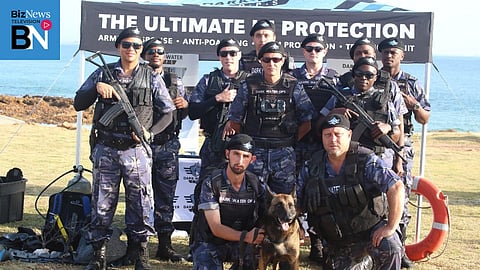
Inside the fight to outsmart multimillion‑rand abalone syndicates with star dog, Zeus – Rassie Erasmus (Dark-Water Ops)
The fight against abalone poaching along the Nelson Mandela Bay coastline is a growing issue that requires innovative solutions. Dark-Water Ops, with its unique approach of utilising trained dogs, has made significant strides in combating this illegal activity that involves international syndicates. Leading the pack is Zeus, a Belgian Malinois shepherd that is so good at his job that he can sniff out abalone in frozen cow offal. In this interview with BizNews, Operations Director Rassie Erasmus explains how this elite private security unit that has had successes including a massive 100-ton bust aims for prevention over pursuit to combat a lucrative illegal trade second only to sardines in value that is driven by demand from East Asian markets.
Sign up for your early morning brew of the BizNews Insider to keep you up to speed with the content that matters. The newsletter will land in your inbox at 5:30am weekdays. Register here.
Support South Africa’s bastion of independent journalism, offering balanced insights on investments, business, and the political economy, by joining BizNews Premium. Register here.
If you prefer WhatsApp for updates, sign up to the BizNews channel here.
Watch here
Listen here
Edited transcript of the interview
Linda van Tilburg (00:00)
Perlemoen poaching along the Nelson Mandela Bay coastline has escalated in scale and sophistication. But one anti-poaching unit is pushing back with an unexpected advantage: highly trained dogs. Dark-Water Ops has been making notable gains, and with us is Operations Director Rassie Erasmus to explain how the unit and their star dog Zeus are changing the game. Hi Rassie, welcome to BizNews.
Before we talk about the unit and how you're addressing this problem, can you give us a sense of how serious the illegal perlemoen problem is along that coastline?
Rassie Erasmus (00:36)
Yeah, the perlemoen poaching at this current stage in the Eastern Cape is very rife. It's become a big problem where all sorts of syndicates are getting involved to get this commodity. At the moment, it's an international organised crime where various countries are involved in this industry. And if you look at abalone, the illegal part of abalone poaching in South Africa, it is the second biggest commodity being traded at the moment, talking fish-wise, and they fall just under the legal side of sardines. So if you take our big sardines in South Africa, illegal abalone poaching is right underneath it. So, you're talking millions and millions and millions of rands of this commodity being exported illegally to foreign countries.
Linda van Tilburg (01:34)
Well, you said that it's also part of international networks. So when you catch these poachers, are they South African?
Rassie Erasmus (01:44)
Look, it happens in stages. This whole thing is staged very well. And the end users are obviously in the East, which is Vietnam, China, and those places. But they send the guys here to process it, to dry it, so that they can export it easier to their countries. But it starts off with a bag runner that's just there to run that bag from the water to the transport vehicle. And so it escalates, escalates until you get to where it is in China, Hong Kong, Vietnam, where it gets exported.
Linda van Tilburg (02:26)
So what makes that piece of coastline particularly vulnerable to poaching syndicates?
Rassie Erasmus (02:34)
The piece of coastline that we monitor and protect here in the Eastern Cape is like a 25-kilometre coastline. It is prime habitat for abalone. It's the right sea conditions. It's the right food for it there. And the ecosystem there is perfect and established for abalone. So that's why it's being so targeted by poachers.
Linda van Tilburg (03:01)
So how did Darkwater Ops become involved?
Rassie Erasmus (03:10)
We came involved through a project with the name Phakisa Project. It is a government project where they try to see if they can make abalone a sustainable fishery that can later help the local communities to generate money in those fishing villages and communities for themselves. So we are the security service provider for this Phakisa Project to protect the abalone farmed and arranged in that piece of coastline where they farm with abalone in natural waters where they plant abalone and then let it grow wild and then later if it's sustainable then start harvesting for the local communities to generate money for them.
Linda van Tilburg (04:00)
When did you start using dogs for that?
Rassie Erasmus (04:03)
We started using dogs, say, from 2017 to help us and assist us with apprehension and detection of abalone while we're busy working in that region.
Linda van Tilburg (04:18)
How successful has that been using dogs?
Rassie Erasmus (04:23)
Very successful. The dog is a wonderful thing. It just amazes you every day working with them and seeing what they can do actually. And we've had big successes. I think in 2015, 2016, we did the biggest abalone bust in South Africa, where it was over 100 tons of abalone. We got back out of containers where it was actually wrapped in cow tripe and then frozen and then our dogs after that through the tripe and then we managed to get containers full of abalone back and then we've got a new dog now Zeus which we use more than tracking and looking for abalone in the bush where these guys hide their abalone when they come out of the water just before it gets picked up. So Zeus and his handler, Johan. They are up and down the coastline every day, walking, tracking, trailing, and then detecting these abalone and get the abalone back.
Linda van Tilburg (05:31)
What kind of dog is Zeus and what makes him so fit for this job?
Rassie Erasmus (05:37)
Zeus is a Malinois, it's a Belgian Shepherd. They've got a very high drive, very agile, very energetic. So the amount of kilometres they walk and the amount of work they do, they need a dog with a very high drive, very fit, very agile. And that's why we choose those dogs to help us in this coastline.
Linda van Tilburg (06:04)
Is he the lead dog?
Rassie Erasmus (06:05)
Yes, we've got six of those dogs spread out along all our units. But he, because he's a specific dog for abalone, he's got the more successes, can we put it that way, in what we're doing in our everyday job. We've got fire arm detection dogs, drug detection dogs that also do their part, but they don't get as much work in everyday situations than what Zeus gets.
Linda van Tilburg (06:42)
So how do you train a dog specifically to sniff out abalone or perlemoen?
Rassie Erasmus (06:49)
It starts from puppy development. So from eight to 12 weeks old, you start with them and they do what they call puppy development. Then they train the dog on its favourite toy. And then afterwards they put that scent that they want, but we use abalone. And that's how you start getting him to sniff his favourite toy and you make the toy smell like abalone and you start hiding it and start playing with it. And that's how he gets that drive to look for abalone because that's actually his toy.
Linda van Tilburg (07:32)
And you said you had, was it five dogs and do you want to expand that programme?
Rassie Erasmus (07:36)
Yes, definitely. We have, as I said, we've got detection dogs, we've got explosive detectives, narcotics, we've got tracking dogs, and then we've got the patrol dogs, which people know as the attack dogs that we use to bring dangerous suspects and so on. So, yeah. But we would like to expand and to make it a bigger unit, yes.
Linda van Tilburg (07:56)
Well, tell us a bit more about Darkwater Ops, the background of the company and what you do.
Rassie Erasmus (08:03)
Darkwater Ops is a private security company established in 2017 as an anti-poaching company. So we do anti-poaching along the coast, which is marine anti-poaching. Then we do anti-poaching in the Big Five areas where we look after rhinos and Big Five. We do farm protection to look after the farmers and their assets. And then we do investigations and undercover stuff and then it's got a section where we do technical work. It's alarm cameras those and then we've got an armed response unit as well like a normal armed response unit that's in your suburbs. We do that as well.
Linda van Tilburg (08:53)
Is that only operating in that area in the Nelson Mandela Bay area?
Rassie Erasmus (08:58)
No, we've got contracts over the Eastern spread over the Eastern Cape. We've got contracts in Franschhoek spray. We had contracts in as far Upper Karoo knowledge. So we are widespread. But what makes us different is we are an elite unit. we move in small groups and we are retrained and we focus specifically on what we do and more on the prevention of something than the chase of something. We try and stop it before it happens rather than chase after it's happened.
Linda van Tilburg (09:35)
I've been wondering about perlemoen: if you seize it because it's still fresh, can you put it back into the sea? What do you do with it?
Rassie Erasmus (09:42)
Unfortunately not. Abalone is a creature that doesn't have a blood clotting agent in its system. So even if it gets small nick or you hurt the skin off of the abalone, it actually bleeds to death. And what happens here is the shell of the abalone is a third of its weight. So while the divers are diving it under the water, they actually de-shell it. So they only take back.
Linda van Tilburg (10:20)
What happens to the seized abalone?
Rassie Erasmus (10:24)
The seized gets booked in to the SAPS 13 where Department of Agriculture, Environment, Forestry and Fisheries come and they collect the abalone and then it gets taken to their facility in Cape Town and I don't know from there they process it and I don't know what happened to it from there but it goes to the department and they handle it from there.
Linda van Tilburg (10:55)
Rassie, what is your biggest obstacle in fighting poaching?
Rassie Erasmus (10:56)
Our biggest obstacle at this moment is unfortunately in South Africa, it's our socio-economic status where there's no funding available for government to assist and to do proper big operations where we can utilise different departments in combating this abalone poaching. So funding from the government side to their own people is a problem at the moment.
And then what we do is, everything we do besides our small area that we need to protect outside that area is on our own account. So funding for us as well, which is sometimes a problem. The equipment being used and that we use are very expensive and they've come along the years now. So it's time to replace all those type of things for us to do the job properly again. So funding and that's our biggest issue at the moment is that there's no funds available for combating abalone poaching in South Africa.
Linda van Tilburg (12:04)
are you self-funded then?
Rassie Erasmus (12:07)
We are self-funded, we are private security company, so we are self-funded, yes.
Linda van Tilburg (12:13)
You don't get any government support?
Rassie Erasmus (12:15)
No, no, we don't get government support at all. We've got a contract like a normal security company's got a contract with a client with an abalone farm, which is part of the Phakisa thing. That's it. So we've got a small contract with them to say that we are their security service provider. That's it. Other than that, we don't have any other funding from outside. And 80% of our work is broader than what we have to do for the abalone farm.
Linda van Tilburg (12:49)
Well, Rassie Erasmus, thank you so much for speaking to us. Do people often compare you to Rassie Erasmus, the Springbok rugby coach?
Rassie Erasmus (12:59)
No, no, I am a bit bigger than him.
