
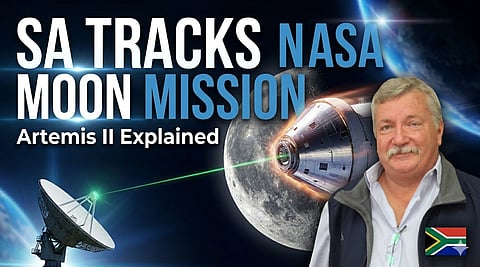
SA’s Hartebeesthoek plays key role in NASA Artemis II lunar flyby & prepares for new space race
South Africa’s Hartebeesthoek ground station has once again proven its strategic value in deep space exploration, delivering critical tracking support for NASA’s historic Artemis II mission, the first crewed lunar flyby in over 50 years. SANSA Space Operations Executive Director Raoul Hodges told BizNews in an interview, how the station’s veteran 12-metre antenna provided essential one-way data to help pinpoint the Orion spacecraft, the excitement in the control room during passes behind the Moon’s far side, and why South Africa’s Southern Hemisphere location remains vital for global lunar missions. Looking ahead, Hodges outlines plans for the new Matjiesfontein ground station and efforts to train the next generation of South African space professionals as the country positions itself for Artemis III, IV and the intensifying international space race. – Linda van Tilburg
Sign up for your early morning brew of the BizNews Insider to keep you up to speed with the content that matters. The newsletter will land in your inbox at 5:30am weekdays. Register here.
Support South Africa’s bastion of independent journalism, offering balanced insights on investments, business, and the political economy, by joining BizNews Premium. Register here.
If you prefer WhatsApp for updates, sign up to the BizNews channel here.
Watch here
Listen here
Edited transcript of the interview
Linda van Tilburg 00:00
South Africa played a role in the historic Artemis II lunar flyby, a moment that has gripped the world as humans travelled further from Earth than ever before. The South African National Space Agency’s Hartebeesthoek ground station was contracted to track the spacecraft alongside other stations around the globe because of its unique position.
I’m joined by Raoul Hodges, Executive Director of SANSA Space Operations, to tell us more. Hi Raoul, nice to have you again at BizNews.
Raoul Hodges 00:43
Thanks.
Linda van Tilburg 00:45
So what exactly was your role in tracking the Orion spacecraft?
Raoul Hodges 00:50
To track a spacecraft such as Orion, you need multiple stations. First of all, you have humans on board, so human life is key. This means you have a backup for a backup for a backup.
A company creates a network on behalf of NASA and selects ground stations around the world, contracting them to track the Orion capsule when possible. You don’t see it permanently — the Earth rotates and the spacecraft travels to the Moon, so visibility shifts between stations. As Earth rotates, different stations get their turn, and that’s how they determine which ground station tracks the spacecraft at any given time.
SANSA does not currently have a very large deepspace antenna, so we use an antenna that provides what we call oneway Doppler or telemetry data. This allows us to measure where the spacecraft is. Using the antenna’s angles and signal timing, we determine how far away the capsule is and how fast it’s moving.
By combining data from three stations, you get an accurate position of the spacecraft. That’s the role we play when we have visibility. The data doesn’t get processed locally; it’s relayed via the antenna and fibre network straight to the owner of the spacecraft.
Linda van Tilburg 02:48
Could you actually see it, and at what stage of its orbit?
Raoul Hodges 03:00
When we acquire the signal, we call it AOS — Acquisition of Signal. When we lose it, it’s LOS — Loss of Signal.
At AOS, the antenna is already parked at the correct look angles, waiting for the spacecraft’s arrival. We don’t see it visually; instead, we see the signal appear on a spectrum analyser. Once the signal comes up, we lock onto it, and the antenna autotracks the spacecraft for as long as it remains in view.
As the Earth rotates, we eventually move out of range. During Artemis II, we had several passes where we relayed data. Sometimes we were the primary station and sometimes a backup. If a primary station fails, another immediately takes over. It’s a complex but wellmanaged system. We’re a small fish in the pond, but we’re in the pond.
Linda van Tilburg 04:18
Did you feel a sense of excitement, or is this just part of your day job?
Raoul Hodges 04:24
The enormity of the mission gripped the world, and it gripped us too. Everyone was watching — on laptops and phones — tracking where the spacecraft was, when manoeuvres would happen, and when communication would drop.
We lost the signal when Orion passed behind the Moon’s far side, because no one can see that side from Earth. Once communication was restored, the data confirmed many of the planned theories. Artemis is about testing concepts — if it works this time, it has to work for the next mission.
Linda van Tilburg 05:24
For those unfamiliar with the station, what makes Hartebeesthoek critical in missions like this?
Raoul Hodges 05:31
If you look at where the Moon sits, and where global plans are heading for 2030, 2035 and beyond, the intention is to eventually inhabit the Moon.
To do that, the first thing you need is communications. Once you place satellites around the Moon, you want continuous coverage. That requires ground stations in both the Northern and Southern Hemispheres. South Africa’s location in the Southern Hemisphere makes it critical.
This was also why South Africa supported earlier Moon missions between 1963 and 1976. The same applies to Australia and South America. The Northern Hemisphere has more stations simply because it has more landmass. You need both.
Raoul Hodges 06:46
South Africa is fortunate to be in the right geographical position, supported by decades of experience. We started in 1958, and nearly 70 years later we’re still active and growing.
Hartebeesthoek continues to expand, and we’re currently building a new ground station at Matjiesfontein in partnership with the Department of Science and Innovation. We expect to complete that by the end of 2027.
Linda van Tilburg 07:35
The antennas you use — when were they built?
Raoul Hodges 07:40
The main antenna we use is a 12metre dish built in 1963. It’s carefully maintained and still works very well. The backup LSX antenna was installed in 1988.
Different missions use different frequency bands — Sband, Xband, Ku or Ka — and the antennas must match those requirements.
Linda van Tilburg 08:20
How do interactions with international space agencies work? Do they contract you directly?
Raoul Hodges 08:29
Space agencies routinely contract one another. Many people think this is big business, but space is actually very collaborative. If a spacecraft is in trouble and passes through your coverage area, you support it. That’s the brotherhood of the space industry.
Commercial agreements do exist, particularly for launches and Earthobservation data, and more ground stations are becoming commercial.
Linda van Tilburg 09:22
Looking ahead, what role could you play in Artemis III, Artemis IV and beyond?
Raoul Hodges 09:33
This all aligns with our strategy. We aim to build ground stations and infrastructure ahead of time so that when Artemis, China, Japan or others need support, we’re ready.
Artemis is a massive programme. A lot needs to reach the Moon before people can live there, and we hope to be one of the players supporting that effort.
Linda van Tilburg 10:43
Is reentry the most dangerous part of the mission?
Raoul Hodges 10:56
There are two particularly dangerous stages: launch and reentry. During reentry, temperatures can reach between about 300 and 5,000 degrees Celsius.
These moments are high risk, but they are carefully engineered and based on decades of proven design.
Linda van Tilburg 12:00
South Africa isn’t just uniquely positioned geographically — you’re actively preparing for this renewed space race?
Raoul Hodges 12:25
Yes. It’s part of our strategy to grow the sector and bring young people into it through training and education.
Linda van Tilburg 12:51
How are you planning to bring young people in?
Raoul Hodges 12:54
We train staff at Hartebeesthoek and deploy them to new facilities like Matjiesfontein. The stations will be linked, but each will require 24hour operations.
That means engineers, technicians, operators and artisans — creating a pipeline of highly skilled professionals.
Linda van Tilburg 13:43
Before we end, how is Matjiesfontein progressing?
Raoul Hodges 13:47
The site was handed over in April, and construction is expected to begin shortly. Facilities and infrastructure should take about 16 months to complete.
Linda van Tilburg 14:10
Raoul Hodges, thank you. You certainly seem to be in exactly the right place.
Raoul Hodges 14:18
Thank you for the opportunity.
Raoul Hodges 10:56
There are two particularly dangerous stages: launch and reentry. During reentry, temperatures can reach between about 300 and 5,000 degrees Celsius.
These moments are high risk, but they are carefully engineered and based on decades of proven design.
Linda van Tilburg 12:00
South Africa isn’t just uniquely positioned geographically — you’re actively preparing for this renewed space race?
Raoul Hodges 12:25
Yes. It’s part of our strategy to grow the sector and bring young people into it through training and education.
Linda van Tilburg 12:51
How are you planning to bring young people in?
Raoul Hodges 12:54
We train staff at Hartebeesthoek and deploy them to new facilities like Matjiesfontein. The stations will be linked, but each will require 24hour operations. That means engineers, technicians, operators and artisans — creating a pipeline of highly skilled professionals.
Linda van Tilburg 13:43
Before we end, how is Matjiesfontein progressing?
Raoul Hodges 13:47
The site was handed over in April, and construction is expected to begin shortly. Facilities and infrastructure should take about 16 months to complete.
