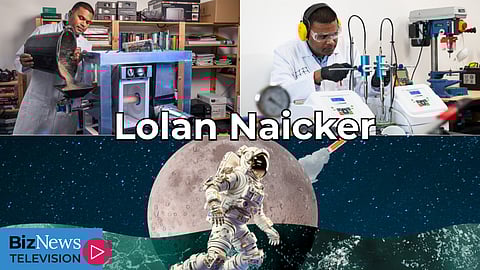
A groundbreaking technology developed by a South African entrepreneur has won the UK Space Agency-funded Aqualunar Challenge. Lolan Naicker’s SonoChem device took the top prize in a competition that featured scientists from some of the UK’s leading universities. His invention uses microwaves to melt ice and ultrasound to filter out impurities from lunar ice, potentially providing astronauts with drinkable water directly from the Moon’s surface. Naicker, originally from Chatsworth in KwaZulu-Natal, told BizNews in an interview that purifying water from lunar ice remains an unsolved challenge. He has identified four potential spin-out technologies from his invention—two for space applications and two for terrestrial use—which have attracted significant interest. The £150,000 prize money will allow him to expand his team, having previously relied on contractors while bootstrapping the venture. This is far from the end for the South African entrepreneur—he says he is surrounded by other partially completed projects, hinting at further innovations to come. .Sign up for your early morning brew of the BizNews Insider to keep you up to speed with the content that matters. The newsletter will land in your inbox at 5:30am weekdays. Register here.Support South Africa’s bastion of independent journalism, offering balanced insights on investments, business, and the political economy, by joining BizNews Premium. Register here.If you prefer WhatsApp for updates, sign up to the BizNews channel here..Watch here.Listen here.Edited transcript of the interview.Linda van Tilburg (00:00.13) Lolan Naicker’s SonoChem system has won the UK Space Agency's Aqualunar challenge—an innovation that could help astronauts purify water from lunar ice. He has joined us in the BizNews studio. Hi Lolan, winning this challenge is such an honour. What exactly is your innovation, and how does it work?Lolan Naicker (00:33.134) Well, the task we were given was to develop a system to purify frozen water in the south polar region of the Moon. This has been explored by agencies like NASA, but no one's come up with a definitive solution, so it's still considered an open problem. I proposed a novel approach called sono chemical degradation. The "sono" part refers to using sound waves to break down contaminants in liquid water. That principle formed the core of the entire purification process.Linda van Tilburg (01:20.352) You were competing against professors from major UK universities for the same challenge, but your design won.Lolan Naicker (01:28.418) Yes, and that was a bit of a surprise. Over 70 teams applied, with 30 submitting sufficiently complete proposals. Ten teams were selected as finalists and received seed funding to develop their technology further. My team was one of those 10, and ultimately, we won the entire challenge.Linda van Tilburg (02:03.746) Tell us more about the Aqualunar Challenge. What exactly is it?Lolan Naicker (02:08.014) It’s a £1.2 million challenge run between the UK and Canadian space agencies, with two separate tracks—one for UK teams and another for Canadian teams.Each track runs independently. UK teams competed against other UK teams, and the same applied to Canada. My company won the UK track, which has now concluded. The Canadian track is still ongoing, with more rounds to go, but the total prize value remains the same—it’s just structured differently.This is the first time the UK Space Agency has run a challenge like this. Similar competitions have been hosted by NASA and the XPRIZE Foundation to encourage innovation. The idea is to propose an unsolved problem, then open the challenge to anyone—whether that’s an established research institution or an individual tinkering with ideas in their garage. The goal is to find fresh, unconventional solutions, with a financial prize at the end to help develop the winning innovation further.Linda van Tilburg (03:47.573) So what happens to your invention now?Lolan Naicker (03:50.67) Well, it was considered promising enough that I was awarded the financial prize, allowing me to continue developing the purification system for lunar water. During the process, I identified four potential spin-out technologies—two for space applications and two for terrestrial use. The Earth-based applications have nearer-term commercial viability, which helps sustain the company while working toward the long-term lunar goal.Linda van Tilburg (04:49.191) So you’re also working on applications for Earth?Lolan Naicker (04:52.098) Yes. The challenge of purifying lunar water requires a compact, low-power system that operates in a harsh environment with minimal maintenance. There are niche applications on Earth where a version of this technology could be useful. I'm currently collaborating with a potential customer to develop an effluent treatment device and have identified another promising terrestrial application, which I plan to pursue further this year.Linda van Tilburg (05:43.167) Tell us more about your company. How many people work with you?Lolan Naicker (05:47.842) It’s a three-year-old research and development-focused company. Initially, I worked as a consultant, helping startups and larger companies develop ideas from concept to first prototype across various sectors, including space.At some point, I realised I could apply that same process to my own technology. The companies I worked with successfully raised millions in funding based on prototypes I helped them build, so I decided to take that approach myself.Since launching, there’s been significant interest in the spin-out technologies. Several companies have reached out regarding collaborations and potential acquisitions should development continue. So far, it’s been a one-person company, but I’ve worked with a regular team of subcontractors—people I’ve collaborated with across industries for the past 20 years. The workload has now grown beyond what I can handle alone, so I’ve published two job adverts and am looking to expand the team..Read more:.BN Briefing: DA VAT victory signals GNU power shift; Mulder: ANC destroys everything it touches.Linda van Tilburg (07:38.079) That all sounds so exciting—you're almost doing this solo! Are you looking for funding, or does it depend on which company takes up your technology?Lolan Naicker (07:48.174) I follow a revenue-generating business model instead of seeking early-stage investment.Many startups begin by securing funding first, spending much of their initial effort trying to attract investors. I took a different approach—offering technical consulting services that generate revenue and reinvesting profits into internal developments. Along with the Aqualunar Challenge prize money, this has given me a financial runway to continue operating independently. I’m open to discussions with investors, but I don’t yet have a business case strong enough for meaningful engagement. The plan is to keep going with this bootstrap model while refining the technology and assessing the next steps.Linda van Tilburg (09:09.96) You're originally from Chatsworth, South Africa. How did that lead to starting your company in the UK?Lolan Naicker (09:17.898) I've worked in various industries, both in South Africa and internationally, always in R&D-focused roles—developing ideas or advancing company projects to prototype stage. I’ve always done this kind of work, but the benefits primarily went to my employers. Over time, I moved across multiple industries—petrochemicals, nuclear, astronomy, household consumer electronics, space technology, cosmetics. The common thread has always been science, engineering, and technology.I enjoy tackling problems with no established solutions, where the path forward isn’t obvious. I like starting with a blank slate and working through challenges others might consider too difficult or unsolvable. About three years ago, I reached a point in my career where I struggled to fit into traditional roles. I looked at job postings and couldn’t neatly fit into any category—I’ve worked across too many fields to label myself as one type of engineer or scientist.To continue operating in this interdisciplinary way—solving complex problems with market potential—I had no choice but to start my own company.Lolan Naicker (11:29.722) I first joined a startup to get a feel for that world. After two years, I realised there were aspects I’d approach differently. So I decided to take the plunge and build something myself. With kids to feed, a mortgage to pay, and just one short contract to start with, I launched the company. Three years on, it’s been a surprise how well this business model has worked—but since it’s working, I don’t question it too much.Linda van Tilburg (11:57.244) And revenue has been growing steadily?Lolan Naicker (12:17.742) Yes, over the past three years, it has reached a point where I can now hire additional people to support the work and see where this takes us.Linda van Tilburg (12:31.91) Any new ideas brewing? Any inventions you’re working on?Lolan Naicker (12:37.17) I always have a backlog of ideas waiting for the right moment. Hopefully, with new hires, I’ll be able to develop more of them. There are partially completed projects surrounding me right now—though the camera’s blurred, you’d see them. They’re ready for the new team to start working on. I focus on getting ideas to prototype stage before moving on to the next one, but I need to improve how I work in parallel across multiple projects. Expanding the company has become essential.