
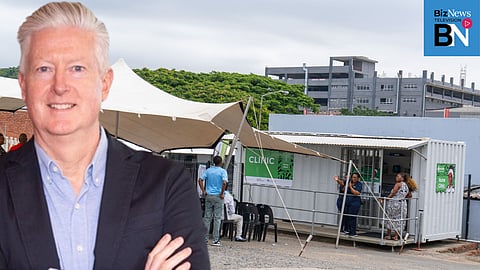
Sha’p Left steps up expansion of nurse-led clinics to close South Africa’s primary healthcare gap – Paul Miller (Cipla Foundation)
While the debate continues around the affordability of the National Health Insurance legislation introduced by the government, an initiative of the Cipla Foundation is helping to address critical shortages in primary healthcare. Sha’p Left nurse surgeries places affordable, nurse-led clinics directly inside community hubs, often at taxi ranks. With a new partnership with the FirstRand Empowerment Foundation, the model is now set to expand. In this interview, Cipla Foundation CEO Paul Miller explains how the organisation plans to scale the clinics across the Western Cape, Gauteng and KwaZulu-Natal, while enabling nurses to become entrepreneurs. He also discusses the Foundation’s work across Africa with Operation Smile, helping to restore smiles to children born with cleft lips and palates. – Linda van Tilburg
Sign up for your early morning brew of the BizNews Insider to keep you up to speed with the content that matters. The newsletter will land in your inbox every morning on weekdays. Register here.
Support South Africa's bastion of independent journalism, offering balanced insights on investments, business, and the political economy, by joining BizNews Premium. Register here.
If you prefer WhatsApp for updates, sign up to the BizNews channel here.
Watch here
Listen here
Edited transcript of the interview
Linda van Tilburg (00:00)
Access to primary healthcare remains a struggle for millions in South Africa. Public clinics and hospitals are often congested, forcing people to wait for hours, and sometimes they lose a full day’s wages just to see a nurse.
The Sharp Left Nurse Surgeries is an initiative of the Cipla Foundation, created to address this challenge by placing affordable, nurseled clinics directly inside community hubs.
Now, with a new partnership from the FirstRand Empowerment Foundation, this model is set to scale. Joining us to talk about the initiative is the CEO of the Cipla Foundation, Paul Miller. Hi Paul, thank you for joining us today.
Paul Miller (00:43)
Thank you, Linda, and thank you for the opportunity to speak about this.
Linda van Tilburg (01:04)
Before we talk about this FirstRand Foundation collaboration, can you tell us a bit more about the Sharp Left Nurse Surgeries? It’s quite a nice name. How does this model work on the ground?
Paul Miller (01:17)
Linda, you started with the introduction by clearly stating the challenge we face in South Africa. So many people are looking for access to healthcare, and for many it is still a privilege. We know that state institutions are congested, overwhelmed and underfunded.
For many people, getting access to healthcare means taking a day’s leave just to go to hospital. At the same time, we know that employment rates in this country are very low. There are many people who have the skills and the capability, but we are simply not deploying them.
From Cipla’s perspective, we saw these as two incredible opportunities. What if we could identify nurses who would be prepared to work in the community and provide access to healthcare at an affordable level for people seeking private care, rather than relying on the public sector?
That was really the intention — bringing these two challenges together and finding a scalable solution through nurses who could expand access to care.
Linda van Tilburg (02:41)
How long has this been going on — these nurse surgeries?
Paul Miller (02:46)
We’ve been building these nurse surgeries across South Africa for many years. What’s exciting is that we’ve now refined the model to the point where nurses can become self-sufficient, earn an income, and operate sustainably and profitably.
Many of these nurses come from the public sector and are looking to build their own businesses. Over the last few years, we’ve focused on education, standard operating procedures, and identifying the best locations — where the greatest need exists.
What’s exciting now is that through our partnership with FirstRand, we’re able to scale this — not just to one, two, or five clinics, but potentially 50 or even 60 over the coming period.
Linda van Tilburg (03:47)
For someone who goes to one of these nurse surgeries, what does it cost them?
Paul Miller (03:53)
For R350, patients receive a consultation plus all their medicine. This model specifically targets communities where affordability is critical. But more than affordability, it has to be quality, accessible healthcare.
At that price point, we can assist with diagnosis, laboratory testing where required, consultations with a medical practitioner beyond the nurse, and we can also dispense the medication needed to treat the condition or alleviate symptoms.
Linda van Tilburg (04:35)
You mentioned the number of clinics you want to scale to. In which provinces will this take place?
Paul Miller (04:41)
Initially, we’re focusing on three provinces: Gauteng, the Western Cape and KwaZuluNatal. The reason for this is that we don’t want to spread ourselves too thin at the start. These are provinces where we already have presence and support.
That said, our vision is national, and we would like every province to be represented over time.
Linda van Tilburg (05:05)
Tell us a bit more about the work of Cipla. This isn’t the only thing you do in South Africa — you also supply vaccines.
Paul Miller (05:14)
We do. We’ve realised that healthcare access isn’t just about acute care. Many people who rely on government facilities for chronic medication — particularly for conditions like HIV, diabetes, asthma or other respiratory diseases — spend an entire day every month or two just collecting their medicine.
We don’t believe that’s acceptable. So we’ve worked with government to decant patients from hospitals and allow them to collect their medication at pickup points closer to where they live, such as taxi ranks.
We now have more than 50 pickup points across the country. This is especially critical for HIV treatment. Missing medication can lead to resistance, and once resistance develops, treatment becomes ineffective, with very serious consequences.
We’re now looking to pair these pickup points with Sharp Left Nurse Surgeries — so patients can collect chronic medication and also receive private acute care in one location. This greatly increases the impact nurses have in their communities.
Linda van Tilburg (07:06)
You mentioned that the nurses are becoming entrepreneurs. Is there a specific story you could share that illustrates the difference this makes?
Paul Miller (07:17)
I won’t single out one person, but many of these nurses come from the public sector. While that work is a privilege, they now find themselves in an environment where they run their own businesses.
They manage rent, utilities, staffing and compliance. They’re also specially qualified to prescribe up to Schedule 4 medicines, which puts them close to the level of a general practitioner.
They conduct screenings, including cancer screening, treat common conditions and dispense medication. Most of these nurses are women, and they quickly become central figures in their communities. Many treat between 300 and 350 patients a month.
The difference they make in transforming access to healthcare in a simple, sustainable way is truly remarkable.
Linda van Tilburg (08:54)
Cipla is originally an Indian pharmaceutical company. Where else in the world, and in Africa, are you involved?
Paul Miller (09:06)
In Africa, we have a significant footprint across the southern region — Mauritius, Madagascar, Zimbabwe and Zambia. In East Africa, we operate in Kenya, Tanzania and Uganda, and further north in Morocco, Algeria and Egypt.
Our main therapeutic areas include respiratory care, cardiovascular disease, diabetes, women’s health, men’s health, oncology, gastroenterology and antibiotics.
Our critical focus is affordable access to medicines. Cipla is well known for its role in HIV treatment. In the early 2000s, HIV medication cost around US$15,000 per year — completely unaffordable for most Africans. Cipla committed to providing treatment at a dollar a day, which transformed access and saved countless lives.
Linda van Tilburg (10:59)
Are you allowed to tell us what FirstRand is contributing financially to this project?
Paul Miller (11:11)
It’s a significant investment — enough to support the rollout of around 50 to 60 nurse units. Each unit is a GMP certified container, purpose built with airconditioning, temperature control and data loggers to protect the medication.
We’re very proud of the partnership we’ve formed with FirstRand.
Linda van Tilburg (11:52)
Do people in the communities know about these clinics? Does word get out?
Paul Miller (12:02)
It spreads very quickly. When we pair clinics with pickup points, there’s a natural draw. We also spend time engaging directly with communities.
The most critical factor is location — high traffic areas like taxi ranks or near shopping centres. At these price points, people see value, and word of mouth does the rest.
Linda van Tilburg (12:41)
Is there anything you’d like to add before we wrap up?
Paul Miller (12:46)
Thank you for the platform, Linda. It’s important to give nurses a voice and acknowledge the impact they’re having.
We talk a lot about National Health Insurance in this country, and these nurses are showing what’s possible — that they have the education, the capability, and the ability to run sustainable businesses while expanding access to care.
Linda van Tilburg (13:32)
Before we let you go, I’d like to ask about you. You previously worked at AstraZeneca, which became very prominent during Covid19.
Paul Miller (13:44)
It’s always awkward talking about yourself. I consider myself privileged to have worked for organisations that put patients first.
Over the past 12 years at Cipla, I’ve seen the passion for affordable healthcare across Africa. Our ambition is to extend that impact from the Cape to Cairo.
We’re also investing in manufacturing across the continent, including facilities in Morocco and Durban, as well as a large distribution centre. For us, it’s about both healthcare and economic impact.
Linda van Tilburg (15:34)
One thing we haven’t discussed is Cipla’s work with children born with cleft palates.
Paul Miller (15:41)
Many children across Africa are born with cleft lips or palates. Without treatment, many won’t survive infancy, and those who do often face stigma and developmental challenges.
We partner with Operation Smile, whose volunteer surgeons and medical teams perform life changing corrective surgeries. Through our Miles for Smiles initiative, we raise funds and awareness.
To date, we’ve helped restore more than 2,500 smiles — and futures — and we’re incredibly proud of that work.
Linda van Tilburg (17:27)
Paul Miller, thank you very much for speaking to us.
Paul Miller (17:30)
Thank you, Linda.
