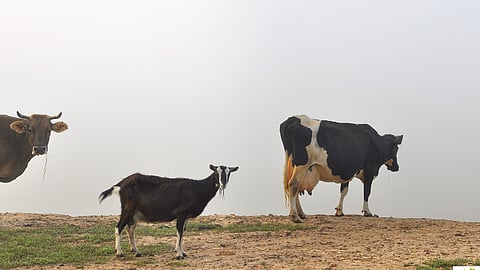
In South Africa's Limpopo province, climate change is forcing a dramatic shift in agriculture. Goats, resilient to drought, are replacing traditional cattle, while staple crops like maize face extinction. With dwindling resources and few alternatives, can this drought-hit region adapt to survive? Simon Kuper explores the stark realities of climate change and its existential threat to southern Africa..Sign up for your early morning brew of the BizNews Insider to keep you up to speed with the content that matters. The newsletter will land in your inbox at 5:30am weekdays. Register here..The seventh BizNews Conference, BNC#7, is to be held in Hermanus from March 11 to 13, 2025. The 2025 BizNews Conference is designed to provide an excellent opportunity for members of the BizNews community to interact directly with the keynote speakers, old (and new) friends from previous BNC events – and to interact with members of the BizNews team. Register for BNC#7 here..By Simon Kuper___STEADY_PAYWALL___.A drought-hit province provides glimpses of the planet's next phase .South Africa's Limpopo region has always been cow country. A bridegroom's family traditionally pays the lobola, or "bride price", in cattle. People here eat the parts of cows they can afford. In a supermarket serving mostly poorer Black shoppers, the butcher's section was selling cow heels alongside chicken feet and "pork head without cheeks". A road sign warning of "stray animals" depicted a cow..Driving around the region, baking in the summer heat, I spotted only one small herd of actual cows: thin specimens picking through the dry grass by the highway. What I saw far more often were goats. They are displacing cows in some areas because they are more climate resilient, explains Kingsley Ayisi, director of the University of Limpopo's Centre for Global Change. Goats can survive on little grass and even eat acacia trees..What's happening in Limpopo is what's starting to happen worldwide: adaptation to climate change. (The other option was cutting emissions, but we collectively chose not to take it.)."Adapt or die", says the cliché. Limpopo is adapting, yet could still die. How can poor regions like this remain viable for human habitation?.Limpopo is South Africa's northernmost province, bordering Mozambique, Zimbabwe and Botswana. Droughts that have always plagued the region have worsened, even if climate change barely features in political debates here. There's nothing unusual about this. "Nearly half the global land area experienced at least one month of extreme drought in 2023," says The Lancet. More than three-quarters of the earth's surface has become drier in the past 30 years, reports the UN..But climate change is existential in an area that already struggled to support human life. A UN official has called southern Africa's current drought (barely noticed outside the region) its worst in a century. Tens of millions of children are malnourished. Elephants looking for food and water stray into human territories near the Limpopo river. Some get eaten..There's little climate tech in Limpopo. The region's small farmers can't afford irrigation. Agriculture here hasn't changed much over the centuries, people still live or die by the rains. A drier climate could doom the region's eternal staples of cattle and maize. Ayisi says farmers should be trained to switch from maize to sorghum, a plant that needs less water. More generally, he advocates finding new foods: "There are over 2,000 edible plants, but the world is feeding on only about 20 to 30. So what happens to those other plants?" Fruits and leafy vegetables growing wild in Limpopo could perhaps be cultivated. "Time is not on our side," he warns..I saw that in the daily produce market in Limpopo's capital, Polokwane. The place is stacked with boxes of tomatoes, potatoes, watermelons and more, most labelled with the names of white Afrikaans commercial farms. A worker told me that climate change was "100 per cent" affecting the produce. Outdoor crops, such as spinach and okra, were arriving withered for want of rain. He pointed to a porter carting away spoiled produce..In theory, agriculture here could survive climate change. "I like the word 'efficiency'," says Ayisi. For instance, shade nets could protect some crops against heat and raise the efficiency of water use. South Africans could improve harvesting of surface and groundwater..But those interventions require capital and efficient government — both scarce in South Africa. "Nearly half the water piped through the country's infrastructure [is] lost through leaks, theft or non-payment," reports Engineering News. The developed countries that historically emitted most CO₂ have promised to help finance the climate transition in poor regions like Limpopo. However, at November's COP meeting in Azerbaijan, rich countries set a funding target of just $300bn a year. Poor countries say they need much more..Limpopo's climate transition probably won't be smooth. What happens then? Several people told me they doubted agriculture here would survive another 20 years. A South African government official said Limpopo should shift to sectors that don't need water: logistics, public services or banking. But that seems improbable in a province short on roads, train lines and well-educated workers..More migrants will leave Limpopo, not for rich countries, but for the nearest metropolis, Johannesburg. Its infrastructure and job market already can't sustain its current population, but southern African climate refugees have few choices. Less resourceful people will be stranded in a drying Limpopo. We are glimpsing the planet's next phase..Read also.The Economist – Powering the future: Grid boom drives global investmentZuma's defiance: Judiciary feud and rising tensions – Patrick MclaughlinElon Musk turns on Farage – urges party to appoint a new leader.© 2024 The Financial Times Ltd.