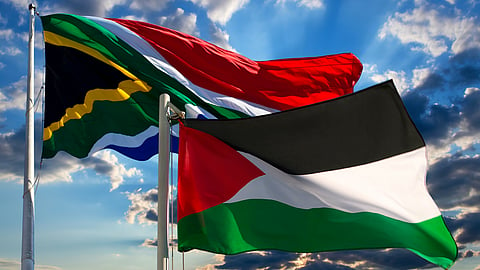
Key topics:SA cancels 90-day visa exemptions for Palestinian refugees.Palestinian identity exploited as political tool against Israel.ANC criticized for supporting Hamas over aiding Gazan refugees..Sign up for your early morning brew of the BizNews Insider to keep you up to speed with the content that matters. The newsletter will land in your inbox at 5:30am weekdays. Register here.Support South Africa’s bastion of independent journalism, offering balanced insights on investments, business, and the political economy, by joining BizNews Premium. Register here.If you prefer WhatsApp for updates, sign up to the BizNews channel here..By Ilan Preskovsky.The major controversy around the two chartered planes of Gaza refugees, which arrived in South Africa under mysterious circumstances last month, recently took an all but inevitable turn for the worse as the department of home affairs cancelled, for the foreseeable future, 90-day VISA exemptions for Palestinians. Conflicting narratives, especially between the governments of Israel and South Africa, have afflicted the issue from the get go, but a couple of things are at least clearer now than they have been. First, that the whole thing was orchestrated by a shady Estonian-Israeli businessman, who through his even shadier “humanitarian organisation” Al Majd Europe, charged Palestinians somewhere in the vicinity of $2000 to be relocated from war-torn Gaza to South Africa. Second, that the response of the South African government was to a) blame Israel for, apparently, using these chartered flights to “flush out” Gaza – a method that at this rate, and rounded up to 200 Gazans per flight, would take 385 years to accomplish – and b) to swear that no more flights of Gazan refugees would be allowed to find refuge in this country. Which is what these people are: refugees. They paid what must surely be, for people in such a dire situation, an exorbitant amount of money, all in the hope of building a new life for themselves and their families after losing everything in a horrendous war in which they got caught. It’s the story of millions of refugees, but instead of treating them as they would escape from any other conflict on Earth, our government instead has used them as yet another tool with which to attack Israel. .Read more:.Forced or facilitated? A gaze behind South Africa’s Palestinian arrivals: Thando Nzimande.But this, really, is the story of the Palestinian people. Instead of treating them as actual human beings with their own agency, their so-called biggest supporters reduce them to little more than political weapons. And it’s been happening for decades. A (Very Brief) History of Palestinianism. “Palestinianism”, as we may as well label this particular phenomenon, is tied directly into the formation of the Palestinian identity and has informed the Palestinian people’s relationship with Israel, the wider Arab/ Muslim world, and the wider international order, ever since. It would take hundreds of pages to even scratch the surface of such an inordinately complicated topic, but it is so crucial in understanding the current state of the Middle East that we have to at least try to come to terms with its basic historical outline.And to pre-empt the pearl clutching, this is in no way Zionist propaganda, but a history that can easily be verified on impartial or even anti-Israel sources all over the web. Just ask, heaven help us, ChatGPT.“Palestinian”, as a national identity for the Arabs living in what is now the State of Israel, the West Bank (Judea and Sameria) and Gaza, first emerged in the late 19th century, but only started to properly solidify after the fall of the Ottoman Empire after World War I. This was, in part, a way for the Arabs of the Levant to assert themselves as more than just subjects of existing empires, and it was also a clear response to the Zionist movement that was growing at the time. Prior to that, “Palestinian” was, for all intents and purposes, a colonial term that was applied to both the Jews and Arabs living in the area. Jews largely embraced the term until the founding of Israel in 1948, whereas the Arabs preferred to be identified first by their tribal identities and then as part of the larger Arab world.Even as Palestinian identity solidified, though, it was still subsumed by the pan-Arab worldview that was prevalent at the time – one that stressed the unity of the entire Arab world, irrespective of borders. This only changed in the 1960s when the Palestinian Liberation Organisation – the predecessor of today’s Palestinian Authority - redefined Palestinian identity as something wholly separate from the wider Arab world, and established the “Nakba” of 1948 as the key traumatic experience that would define Palestinian identity going forward. This change in what it meant to be Palestinian began in 1964 with the creation of the PLO, but was cemented after the Arab world’s humiliating defeat during the Six Day War of 1967, which ended with Israel seizing the West Bank and East Jerusalem from Jordan and Gaza from Egypt.The Weaponization of PalestiniansNone of this is to deny the connection of Palestinian Arabs to the land or to say that they do not have legitimate grievances resulting from a turbulent and bloody century. And it’s certainly not to challenge the legitimacy of “Palestinian” as a national identity. Such attempts to challenge the validity of either “side” in the conflict is, at best, a dead end, and at worst, something that has proven to be deeply destructive for everyone involved.The reason the history of Palestinian identity is so important to understand is because of how it has been manipulated and exploited by Israel’s enemies, both regionally and internationally, from the early 20th century (especially after 1948) until today.Prior to the PLO hijacking the term after the Six Day War, Palestinian identity was defined as being part of the larger Arab world, but with an emphasis on local traditions and culture. This was certainly true in 1948 when the Arab League unsuccessfully attempted to wipe out the newly formed State of Israel and it was true during every other attempt over the next two decades. After losing the Six Day War so very thoroughly, capping twenty years of failure after failure to achieve its goals, the Arab world shifted strategies dramatically. Aside for the Yom Kippur War in 1973, which was mostly just about revenge for the humiliation of 1967, Israel’s enemies decided that rather than trying to overwhelm Israel militarily, it would instead start using Palestinians to do their dirty work. First, as a localised militia that would be able to hit Israel where they could not, and second as a way to completely shift the narrative: no longer would Israel be seen as a David in a sea of Goliaths, it would now be Goliath to the Palestinians’ David. As strategies go, it was pretty brilliant, but it came with a huge cost: to Israel, yes, as its international reputation has eroded over the years, but most especially to the Palestinians, who were forced into the role of perpetual victims; robbing them of empowerment, of any chance of improving their own circumstances, and of a positive, rather than negative, national identity. It also gave rise to an increasingly radical Islamist culture that helped entrench a zero-sum mindset in future generations of Palestinians where negotiations with Israel became a weakness and the utter eradication of the Jewish State as the only acceptable outcome. A New Middle East?In very recent years, however, the Middle East has started to shift. Sunni extremism, as exemplified by ISIS and Al Qaeda and sponsored by Saudi Arabia, rapidly declined and a tendency towards modernisation and moderation in the likes of the UAE, Bahrain and Saudi Arabia itself saw attitudes change drastically towards Israel. These countries realised that Israel was going nowhere and that developing a relationship with the Jewish State would be enormously beneficial, both economically and in terms of security in the wake of an increasingly belligerent Islamic Republic of Iran. Though they still clamour for a Palestinian state and call out Israel just enough to satisfy the hard-liners in their countries, they have largely shifted away from the decades-long tradition of using the Palestinians as a tool against Israel. Which is why not only have they joined the Abraham Accords, they have been far more vocal in their condemnation of Hamas and in calls for the terror group to disarm and surrender than many in the West have. .Read more:.Tim Flack: How over 100 Gazans quietly flew to SA, and how the story was twisted online.Sadly, their ideological opposites, the Shia-ruled Islamic Republic of Iran have picked up the baton as the world’s chief sponsor of terrorism. And in its aspirations to set up a radical Islamist caliphate across the Middle East, have allied with Qatar and Hamas (both of which are Sunni), to target Israel through a mixture of terrorism, “lawfare”, and the fostering of a cultural climate in the West that would turn on Israel. Hence October 7th and its aftermath, where once again, the exploitation and taking of Palestinian lives proved to be Iran’s most potent weapon against Israel. South African ComplicityBut this is about the Middle East. How exactly does South Africa, who has no obvious skin in the game, fit into this? It shouldn’t, of course, but because our government (though most especially the ANC) has sided, almost without fail, with the Islamic Republic of Iran and Hamas over the past two years, it has become a particularly devastating part of Iran’s overall strategy to isolate Israel on the world stage.The why of it all is rather complicated, as the ANC as an organisation doesn’t actually share an Islamist worldview and for all that it may accuse Israel of apartheid and genocide, it has never, to the best of my knowledge, objected to the existence of a Jewish state. At least, not officially. The ANC has, however, used the Palestinian cause as a way of deflecting from its own failures and it wouldn’t be a stretch to imagine that it has profited from its close relationship with the Mullahs in Iran. At the same time, it also clearly feels a genuine loyalty and kinship towards the Palestinian people, while resenting Israel for its relationship with Apartheid South Africa. It’s also especially hard to ignore how much influence Gift of the Givers and its founder have had on the ANC when it comes to all things Israel/ Palestine, and the apparent connections between GOTG and radical Islamism are troubling to say the least (as I have explored elsewhere). And yet even if we can give the ANC at least some benefit of the doubt in its intentions, it doesn’t change that willingly or unwillingly, through the influence of outside forces or not, it has been playing right into the Islamic Republic’s hand. What this means, practically, is that rather than help the Palestinians, the ANC has done an inordinate amount of damage to them. This can be seen clearly in the shameful way our government has handled these Palestinian refugees, as it has opted for moral posturing and political points-scoring over actually helping actual Palestinians. Even more egregious, though, is the ANC’s outright refusal to ever call on Hamas to surrender, disarm, and release the Israeli hostages, which would have ended almost immediately, and tens of thousands of innocent Palestinian lives could have been saved. Instead, from 8 October 2023 to today, the ANC has stood firmly by Hamas and with every word or action of support, played an essential part in empowering a terror organisation that proudly uses the wholesale death of their own people as a key part in its war strategy.Even now, with the next phase of the ceasefire deal hanging on Hamas’ agreement to disarm and/ or leave, the South African government refuses to step up. Shame on them for allowing Hamas and Iran to continue their exploitation of ordinary Gazans - and pity any of us who have fallen for their duplicitous moral theatre.