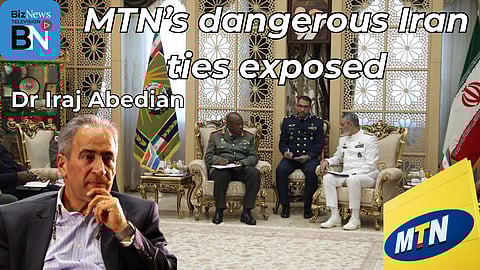
Iranian-born and bred economist Dr Iraj Abedian is baffled by loyalty expressed by SANDF general to his homeland’s theocratic regime - arguing it carries zero upside and substantial downside for South Africans. Abedian says those who pay General Rudzani Maphwanya’s salary - and soon his generous pension - should be demanding an explanation. In this insightful interview, the academic-turned-entrepreneur also offers context on the significant challenges its Iranian connection is causing MTN. He spoke to BizNews editor Alec Hogg.Sign up for your early morning brew of the BizNews Insider to keep you up to speed with the content that matters. The newsletter will land in your inbox at 5:30am weekdays. Register here.Support South Africa’s bastion of independent journalism, offering balanced insights on investments, business, and the political economy, by joining BizNews Premium. Register here.If you prefer WhatsApp for updates, sign up to the BizNews channel here..Watch here.Listen here.Timestamps.00:00 – General Maphwanya’s Iran trip shocks SA01:00 – Who is General Maphwanya? Combat record and influence02:10 – History of SA’s shifting ties with Iran05:40 – MTN’s entry into Iran and business links06:00 – Iran today: population, geography, culture07:25 – Iran’s system: theocracy not democracy09:15 – “You can’t argue with God” – Abedian on repression10:15 – Why would SA’s defence chief back Tehran?12:15 – Zero benefit, huge risk for South Africa13:10 – Government silence and possible US exposure15:30 – Opposition muted, ANC veterans’ ideology17:20 – Cabinet incoherence and dangerous timing18:25 – Dirco turmoil: Director-General job hunt19:30 – Ramaphosa faces a test of leadership21:00 – South Africans pay the bill – taxpayers’ reminder21:45 – MTN’s Iran partner tied to Revolutionary Guard23:30 – Tech used to suppress Iranians and fuel terror25:25 – MTN faces US court cases and class actions26:25 – Best way forward: transparency or consequences27:10 – Closing thoughts – Abedian on truth and damage control.BizNews Reporter.The biggest diplomatic story shaking South Africa this past week was General Rudzani Maphwanya’s surprise trip to Tehran. The head of the South African National Defence Force stood shoulder to shoulder with Iran’s clerical regime, offering words of solidarity at a time when Pretoria’s relationship with Washington could least afford the strain.Speaking to BizNews, economist Dr Iraj Abedian, who spent his first twenty years in Iran before moving to South Africa, unpacked the layers of history and politics that make this move both baffling and dangerous.A General with real statureThis is not a mere political operative, Alec Hogg reminded Abedian. General Maphwanya carries weight. He commanded troops in the Central African Republic in 2013 in what was arguably the SANDF’s most significant foreign combat engagement. He also led operations to uproot Islamic insurgents in Mozambique. A decorated soldier with real credibility, Maphwanya’s actions carry more meaning than the posturing of career politicians.That is what makes his embrace of Tehran so troubling.A troubled history of tiesAbedian explained that relations between South Africa and Iran have been long and often contradictory. In the early 1980s, when Saddam Hussein’s Iraq invaded Iran, Pretoria actually armed Iraq. South African long-range guns were turned on Iranian soldiers, even as South African diplomats postured as peace brokers in Baghdad.Ironically, Israel was selling weapons to Iran at the same time to counter Saddam. Only later, as the Cold War shifted and the US bombed Iraq for suspected nuclear work, did South Africa strengthen ties with Tehran.Over time, commercial and military connections deepened. MTN’s entry into Iran became the jewel in that relationship. But as Abedian pointed out, MTN’s local partner in Iran is the Islamic Revolutionary Guard Corps — a paramilitary network branded a terrorist organisation by the EU, US, UK and Canada. That partnership remains a ticking time bomb.Iran todayIran is a nation of 90 million people, slightly larger than South Africa, with deserts, forests, snowy mountains and oil-rich southern plains. But politically, Abedian says, it is no democracy. It is a theocracy, run by mullahs who claim to govern in God’s name. Elections are stage-managed. Candidates must pass religious tests, not just political vetting.“It’s like the Middle Ages when the church ruled Europe,” he said. “If you disagree, you’re fighting God. And that gets you prison or execution.”This is the regime South Africa’s military chief publicly embraced.No national interestSo what could possibly explain Maphwanya’s mission? Abedian is blunt: “From a national interest point of view there is nothing. No security benefit. No economic gain. Only ideology.”He speculates that South Africa may be exploring weapons technology swaps with Iran, though Iran itself is already advanced in missile development. Even if that is true, the risks outweigh the rewards.Washington is already scrutinising Pretoria after its flirtations with Moscow and Beijing. Aligning militarily with Tehran — a nation locked in daily proxy wars in Lebanon, Iraq and Yemen — risks damaging trade and investment ties with the West.Silence from governmentPerhaps most troubling is the silence. The general has not been disciplined. The defence minister merely said the trip was “authorised,” without explanation. Parliament has not called him to account.Abedian warns that this approach is naïve. “If there is a cover up, it won’t last. The Americans and Israelis most likely have recordings of every conversation he had in Tehran. If needed, they will release them.”The fallout could land squarely on President Cyril Ramaphosa’s desk. Either he defends the general and explains why this aligns with South Africa’s interests, or he disciplines him to protect national credibility. To do nothing, says Abedian, is to let governance collapse into incoherence.MTN’s shadowThis saga also casts a longer shadow over MTN. Already facing court cases in the United States alleging its technology was used to kill American soldiers, the company’s ties to Iran’s Revolutionary Guard look more toxic by the day. Iranian dissidents say MTN’s networks are used to track and jail protestors. Investors are raising ESG red flags.As Abedian puts it, “You’re partnering with a terrorist group. And your technology is helping them suppress people. That adds another layer of risk for a listed company.”A moment of truthSo where does South Africa go from here? Abedian is clear. The best option is transparency. If the general and the minister believe the trip truly served the national interest, they must explain themselves openly to the public. If they cannot, the cabinet must act decisively to preserve credibility.“The more we hide, spin or make it ideological, the more our interests will be compromised,” he said.It is a sobering warning. In an era where trade relationships can be broken overnight by the wrong gesture, one general’s ideological trip may cost South Africa far more than it can afford.