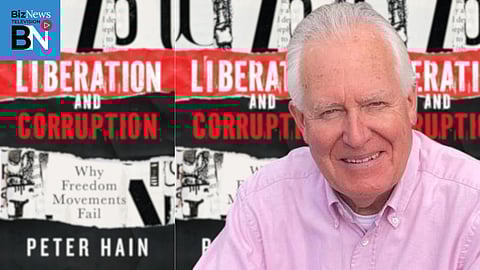
The former British Cabinet minister and lifelong anti-apartheid campaigner, Lord Peter Hain, has published a new book, Liberation and Corruption: Why Freedom Movements Fail. In it, he explores why idealistic liberation movements so often fall into the trap of becoming corrupt. And he has a scathing verdict for the ANC; “Mandela would be turning in his grave, he says at what has happened to his legacy and the way it’s been deeply prostituted and betrayed.” Hain reflects on decades of solidarity with the ANC, his personal ties to Nelson Mandela, and the heartbreak of watching comrades abandon their ideals. He names Jacob Zuma as a key figure in the “industrial-scale looting” that hollowed out South Africa’s economy. But this isn’t just a South African story. Hain connects the dots globally, from Nicaragua to Algeria, and says liberation movements often inherit corrupt colonial systems and fail to dismantle them. He also calls out Western complicity, citing billions laundered through UK and US financial systems, and urges global powers to take financial crime seriously. His solution? A new International Anti-Corruption Court, backed by South African jurists like Judge Richard Goldstone. And a call to citizens: reject petty bribery..Sign up for your early morning brew of the BizNews Insider to keep you up to speed with the content that matters. The newsletter will land in your inbox at 5:30am weekdays. Register here.Support South Africa’s bastion of independent journalism, offering balanced insights on investments, business, and the political economy, by joining BizNews Premium. Register here.If you prefer WhatsApp for updates, sign up to the BizNews channel here..Watch here.Listen here.By Linda van Tilburg.The former British Cabinet minister and lifelong anti-apartheid campaigner, Lord Peter Hain, has published a new book, Liberation and Corruption: Why Freedom Movements Fail. In it, he explores why idealistic liberation movements so often fall into the trap of becoming corrupt.In an interview with BizNews, Hain said he wrote the book because the issue haunted him. Studying examples of other freedom movements, from the Sandinistas in Nicaragua to the FLN in Algeria and the ANC in South Africa, he said he was seeking reasons why it happened almost without exception across the world.Having supported the freedom struggle and worked alongside the ANC, knowing Nelson Mandela and the movement's leaders, he reflected on "how it became in government a betrayal of its values."His parents, he said, made sacrifices, and he fought a lifelong battle. “I didn’t do it to see my comrades putting their hands in the taxpayers’ pockets in the way that they have done so shamelessly and continue to do,” he said. This legacy, he said, was trashed, particularly by Jacob Zuma. When there was "shameless looting on an industrial scale", South Africa lost a fifth of its wealth. The National Treasury is virtually bankrupt.Asked how Nelson Mandela would view the ANC of today, he responded, “Nelson Mandela would be turning in his grave at what has happened to his legacy and the way it’s been deeply prostituted and betrayed,” Lord Hain said.Lord Hain points to the corrupt colonial model that liberation movements inherit as the seed of corruption. He says that when liberation parties take power, they step into the same rigged system and rarely dismantle it. He notes that you can see this across the world, from the Sandinistas in Nicaragua to the ANC in South Africa, where "in power they become as corrupt as their predecessors."In his book, Lord Hain describes how the West is deeply complicit in corruption. And it is not only corporates like Bain & Co, he said, but also governments. Money laundering, he said, is a massive multi-trillion-pound business of robbery and looting on a gigantic scale and is not going to be dealt with unless the governments of the United States, the United Kingdom, China, India and the UAE address it. "The UK", he said, has around £90 billion of looted money laundered through its systems every year, and the US similarly.Unless you get these governments to fight financial crime, he said, “It will continue.” Corruption, he stressed, is not an African phenomenon. "You get corruption amongst whites," he said, citing Britain's COVID PPE scandals where "prominent people [were] looting through providing or pretending to provide personal protective equipment."Lord Hain declined to predict whether the ANC can reform itself but drew a lesson from the anti-apartheid struggle and said transformation is a long process. “We were naïve in thinking the job was done in 1994,” he said. “These battles are never won. They’re continuous battles that have to be fought by successive new generations.”His proposed solution is a new International Anti-Corruption Court, an initiative already demanded by eminent South African jurists like Judge Richard Goldstone. Hain is actively trying to persuade the UK government to support this effort. More immediately, he urges South African citizens to reject petty bribery as the essential first step towards systemic change.