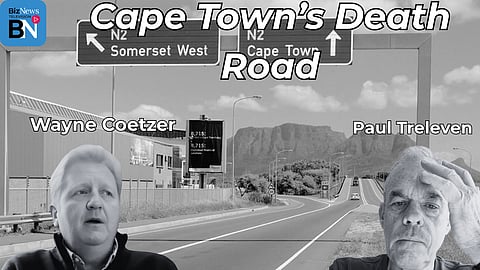
Wayne Coetzer and anti-crime activist Paul Treleven share chilling first-hand accounts of deadly attacks along the N2 highway near Cape Town International Airport. With boulders hurled at cars, tourists targeted, and law enforcement absent, they warn Alec Hogg that without urgent action the Western Cape’s booming tourism and wine industries could face devastating consequences..Sign up for your early morning brew of the BizNews Insider to keep you up to speed with the content that matters. The newsletter will land in your inbox at 5:30am weekdays. Register here.Support South Africa’s bastion of independent journalism, offering balanced insights on investments, business, and the political economy, by joining BizNews Premium. Register here.If you prefer WhatsApp for updates, sign up to the BizNews channel here..Watch here: .Listen here:.Highlights from the interview.Cape Town has been winning global awards and glowing reviews as one of the world’s best travel destinations. Tourists pour into the city for its wine, its scenery, and its vibrant culture. But for those landing at Cape Town International Airport and heading towards Somerset West, Hermanus or Elgin, there is another story, one that never makes the glossy brochures. Locals call it “running the gauntlet” and it is a stretch of the N2 where rocks rain down on cars, families fear for their lives, and tourists become sitting ducks.Two men, wine estate boss Wayne Coetzer and anti-crime activist Paul Treleven, told BizNews editor Alec Hogg why this road has become one of the Western Cape’s most dangerous and how years of warnings have been ignored. Their stories are as personal as they are frightening.A son almost killedWayne Coetzer runs Vergelegen wine estate, one of the Cape’s most famous farms. His staff use the N2 daily and two of them have already been victims of smash-and-grab attacks and rock throwing. But it was his son’s ordeal that brought the threat home in the most brutal way.“At 5.30 in the afternoon, just after the airport, a boulder was thrown through his car,” Coetzer says. “If it had been an inch closer it would have killed him. It went through the back window and landed in the back seat. We do not go into Cape Town after 5.30 anymore.”The family has changed its routine around the danger. And for the wine estate, which welcomes more than 100,000 international visitors a year, the risk is both personal and commercial.“My biggest concern is not only our people who drive that road daily, but the tourists. Every international buyer, every wine lover, has to use that road. If something happens to them, it turns off the taps for every hospitality business in this valley,” he warns.A Sunday drive turns into terrorFor Paul Treleven, the issue is no longer abstract. On 13 August, he and his wife were driving back from Hermanus to catch a flight. What happened next reads like a crime thriller.“As we passed under the Muizenberg bridge, I saw a figure behind the barrier and then suddenly a block of concrete came flying at us. It went straight through the passenger window. My wife had bent down to put her handbag at her feet and that saved her life. The rock smashed into the headrest where her head would have been. The glass cut her face and her eyes. She screamed that she could not see.”Shaken and bleeding, the couple tried to escape but soon found themselves targeted again. Two men in a car pulled up alongside, shouting that Treleven had hit a child and demanding that he stop.“I knew it was a setup,” he says. “They cut in front of me, slowed down, put their hazards on and tried to box me in. I swerved around them and drove straight to the airport. All the while I was calling the emergency number, and to this day nobody has answered.”Twenty Years of warningsBoth men are adamant this is not an isolated wave of attacks. Treleven says the violence has been happening for 21 years. Tourists have died, South Africans have been shot after stopping on the roadside, and countless unreported attacks make the official statistics meaningless.“I have been digging into the history,” Treleven explains. “At least four tourists have been killed on that stretch, and many locals too. A week after our incident a woman pulled over with a flat tyre and was shot in the head. Hundreds of cases are never reported. People know the police will do nothing.”Coetzer calls the road “apocalyptic” and says the first impression of international visitors is a landscape of burning tyres, litter, stray dogs and children dodging traffic. “You see horses, rubbish, smoke. And then suddenly rocks flying at cars. This is what tourists see as their first introduction to Cape Town,” he says.The silent threat to tourismCape Town’s reputation as a world-class destination hangs on a fragile thread. One incident involving the wrong person, warns Alec Hogg, could undo years of branding. “Imagine it happened to a New York Times reporter, or a top wine buyer,” he says. “The damage would be irreparable.”Tour operators are already nervous. Coetzer admits that many prefer farms closer to Cape Town for safety. “They do morning excursions but avoid late pickups from the airport,” he says. “And who can blame them? When international flights land late at night, the risk is enormous.”What can be done?Both men agree on urgent fixes. Treleven wants working cameras, permanent police patrols, and most of all a solid concrete wall to separate the highway from neighbouring settlements. “The mayor admitted to me the cameras do not work. If there was political will, that wall would have been built years ago. It would already have saved lives,” he says.Coetzer believes private sector partnerships could play a role. “We need leadership. The municipality cannot do it alone. Companies along the route, fencing contractors, logistics firms, the wine industry, we could all collaborate. This is our livelihood. Now is the time.”A community left exposedBehind the sensational headlines lie ordinary families, staff commuting daily, and children forced to play soccer next to the highway. “There are no safe crossings, no facilities,” Coetzer says. “Kids run after balls into the road. Dogs get hit. It is horrific. Something clever has to be done, not only for motorists but for the people who live here.”The men stress a simple rule for survival: never stop. Even if tyres are blown, locals say drive on the rims until you reach safety. Stick to the middle lane and avoid travelling alone.A crisis hiding in plain sightCape Town is rightly celebrated for its beauty and its economic potential. But just four kilometres of the N2 expose a reality that undermines that story. Visitors, investors, staff, and families are all at risk while the problem festers.The phrase “running the gauntlet” is no longer a metaphor. It is the daily reality for anyone leaving Cape Town airport and turning left towards the Helderberg. Until the warnings are acted on, every journey carries the same haunting question: who will be the next victim.