
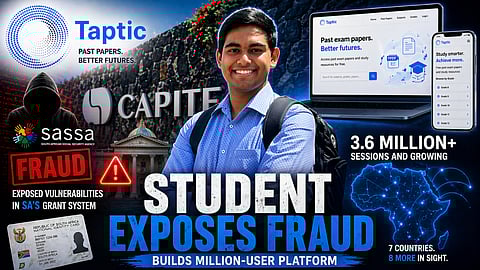
Stellies student who built edtech Taptic and took on SASSA fraud eyes Africa expansion – Veer Gosai
Stellenbosch student‑turned‑founder, Veer Gosai, built an edtech platform serving millions of school pupils with free past exam papers – and he’s not only a tech entrepreneur. A stolen ID led him to uncover fraud in the SASSA grant system. In this BizNews interview, Gosai talks about how his exam‑prep platform Taptic has expanded to seven African countries, with another eight in his sights; why he believes AI is detrimental to the youth in a country where more than 80% of Grade 4s cannot read for meaning; and, in an interesting titbit, how his data shows that Grade 9s are the “laziest” learners in South Africa. – Linda van Tilburg
Sign up for your early morning brew of the BizNews Insider to keep you up to speed with the content that matters. The newsletter will land in your inbox every morning on weekdays. Register here.
Support South Africa's bastion of independent journalism, offering balanced insights on investments, business, and the political economy, by joining BizNews Premium. Register here.
If you prefer WhatsApp for updates, sign up to the BizNews channel here.
Watch here:
Listen here:
Edited transcript of the interview
Linda van Tilburg (00:00)
Veer Gosai is a young South African entrepreneur and founder of Taptic, an edtech platform that helps millions of skilled pupils to prepare for exams by giving them access to past exam papers. His interest does not only lie in helping pupils with exam prep; he has also exposed security vulnerabilities in SASSA’s grant payment system and weaknesses inside major banks. And he joins me in the studio.
Well, before we get to your studies, I think there’s something we need to discuss, and that’s the SASSA story. How did you uncover fraud and the vulnerability inside South Africa’s grant system? Don’t tell me you hacked them.
Veer Gosai (00:58)
I’ll tell you what, every interview I do for the rest of my life, this will always be talked about, because I think it’s such a cool story. It started from my curiosity. I found out a friend of mine, who I did this with, had his identity stolen. I thought, what are the odds of that, let me check my ID number. Then I found out my ID was also stolen and someone was claiming my SASSA grant. This is not something I had tried to apply for before.
From there, I used some of my technical abilities to dig deeper, and next thing you know, I landed up in Parliament and was presenting to the minister on my data-modelling findings of an anomaly in the SASSA grant system. There were too many people who had applied for the grant. That’s the basic story.
It combines my technical ability with my social-impact side to identify a real, big issue in a country’s social grant system.
Linda van Tilburg (01:59)
So is that what led to you also helping banks to uncover their vulnerabilities?
Veer Gosai (02:05)
I would like to say that when I began my career in cybersecurity, curiosity got the better of me. I tell every South African: don’t ever do what I do, because you can get into big trouble, especially when you don’t have permission to target specific companies. If you are going to do that, make sure the company you are looking at has a responsible disclosure policy, which is a set of guidelines to say, hey, you’re allowed to look at this.
If they don’t have one, stay away completely, because you can get into big trouble.
Linda van Tilburg (02:40)
I could just quickly relate here. I won’t mention names. I know of a student who hacked into a school in Stellenbosch and eventually—I don’t know whether he changed his marks or whatever he did—but eventually he became a tech entrepreneur in South Africa and he was backed by a big billionaire. So just that story.
Veer Gosai (02:59)
I think cyber is often seen as this thing that’s very cool and where you make a lot of money. It’s dangerous. Unfortunately, if a company or government department comes after you, it’s not great. Rather stay on the legal side of things always.
Linda van Tilburg (03:17)
Okay, let’s talk about Taptic. Where did the idea for SA Papers come from? What problem were you trying to solve?
Veer Gosai (03:23)
Taptic predates all the SASSA cyber stuff. This is pre‑AI. Around the end of Covid, I was writing a physical science exam in high school. I’m from Johannesburg originally, Fourways High School. I’d finished my physics exam and I was thinking about the previous night’s studying, and it was a terrible experience trying to find past exam papers.
At the time, I wasn’t very skilled in technical things and IT, but I had a good Python background. I said, I’m going to go and build a website. That holiday, I asked my dad for 300 rand and said, hey Dad, can I register a domain and get a web‑hosting plan? He said, go ahead. I was so excited, I spent the entire holiday building SA Papers, which is what eventually became Taptic.
After about ten months of me building the site and it being in operation, we made our first rand. It’s a complicated process to get approved for AdSense, and a kid like me was underage, so I had to get my dad to do it. It was complicated, but basically after ten months we started making a bit of money. In that very first year of operation, which was 2022, we had around 10,000 people visiting the site. I was jumping up and down. At the time, it was so many people, I couldn’t believe it. And now we’re here today where we’ve just crossed over 3.6 million sessions, so it’s definitely grown over time.
Linda van Tilburg (05:07)
I remember how difficult it used to be to get access to exam papers. Literally, if somebody’s parent wasn’t a teacher, I remember we bought papers from other students just to get access to old exam papers. So you’re clearly filling a need.
You said you’re making money. What is the business model behind Taptic?
Veer Gosai (05:29)
At the end of the day, the first thing to cover is that all the documents we host and publish are open source and freely available to the public. Our business model is very much focused on the economy‑of‑scale principle. We’re not going to charge you one rand per paper or put a paywall there, because that’s actually illegal. But we tell you that you’re more than welcome to visit our site; we’re always online.
We generate money similar to a news company or an organisation like YouTube. We put ads on our site through Google AdSense and that’s how we generate most of our revenue. That funds the product, pays our staff, funds marketing, and that’s the full business model.
Linda van Tilburg (06:12)
So no subscription fees or anything.
Veer Gosai (06:15)
We’ve looked at offering maybe a more premium product, whether there’s an AI integration or personalised videos, but we don’t believe there should be a subscription model for this. The only reason we can operate at such a scale and impact so many lives is because we don’t have a paywall.
In fact, one of the big internal arguments we always have is whether to switch on blocking people who have ad block. If you visit our sites and you have ad block, we don’t let you in. Funny enough, 60% of our traffic is people with ad block on. We ask, should we block 60% of people visiting our site, and we say no, they are still students. They might have just installed a browser extension or something, but we believe that it doesn’t matter what your circumstances are. We don’t care; we just want you to get access to whatever you want, as quickly as possible.
Linda van Tilburg (07:13)
How do you plan to expand, or do you plan to bring other services in?
Veer Gosai (07:19)
We’re working on other services, but we’ve primarily targeted our expansion across countries. We started SA Papers and then thought, let’s pivot. If it works in South Africa, we can maybe replicate it in a foreign market. So we went to Rwanda first and started Rwanda Papers—I know the name is very similar—and Rwanda Papers was just as successful.
From there, our expansion plan is a five‑year plan where we target specific countries in specific quarters of each year. Right now, we’re in seven countries across the world, all in Africa, and very soon—hopefully by the end of the year—we’ll be in 15 countries.
Linda van Tilburg (08:04)
What feedback are you getting from students, from pupils in South Africa—learners, as they call them?
Veer Gosai (08:10)
We love using South African learners and uni students that I talk to, who used our product in matric. We get a lot of feedback from them about what they want to see, whether they don’t like how something works or whether they want a premium product. We get a lot of feedback, but we try to take it all and combine it every year into goals: we want to implement specific features, or a specific group of students wants an additional premium paid service.
We try to funnel it in a way that’s effective so that the most students are happy. At the end of the day, with 3.6 million visits last year, if you look at our support messages, there are hundreds of them—hundreds of students with ideas. You’ll get the odd student who is reporting bugs on the site that we have to fix. We try to take all that feedback and, at the end of the day, build something that’s better than last year.
Linda van Tilburg (09:16)
You’re at Stellies. How do you juggle the balls—keeping them in the air—of studying full‑time and running a growing platform?
Veer Gosai (09:26)
I’ll tell you what, my weekends are not very free. With any founder or entrepreneur at university, your work week is going to be uni, and then you still have an additional lot of work. But at Taptic, we’re a very student‑run business. There are six other people involved in the business, all students between Stellies and Wits and private educational institutions in South Africa. Our team works together to perform specific tasks, and they do it to the best of their abilities.
We have a dedicated person who does our marketing—she’s great. Our Instagram is nearing 50,000 followers. We have a dedicated developer for an app that we’re working on and taking into beta. We’ve got a dedicated developer for chatbots, and we have a team around us that really keeps this alive and keeps it going.
Linda van Tilburg (10:25)
Are you going to stay with the platform? Cybersecurity with AI makes it so much more complex. Is that the direction you see yourself moving into?
Veer Gosai (10:35)
For me personally, I’ll definitely pivot to the cyber space. I’m working on some really cool things in cyber for organisations, but at the end of the day, Taptic is something successful and something that has great impact, and I’ll always be involved in it. I might step down as the chief executive officer and hand that over to another one of our passionate staff members, and continue working from a more advisory perspective.
But at the end of the day, I’ll always be involved because of the impact it has.
Linda van Tilburg (11:08)
What are you studying, and when are you completing your studies?
Veer Gosai (11:12)
I’m studying a Bachelor of Science in Geoinformatics with Computer Science. I know the degree sounds weird, but people are often intrigued by it. Basically it’s computer science with a GIS specialisation—geographical information systems—and satellite mapping. It’s very fun, in my opinion.
I have just about one and a half years left, so I’ll be class of 2027, graduated. Once I’m out of uni, I guess I can do entrepreneurship full‑time, which would mean I have a lot more free time to work in the business.
Linda van Tilburg (11:59)
Just the last question: how does AI impact everything you’re doing on the edtech platform and with cybersecurity?
Veer Gosai (12:05)
I have a very unpopular opinion when it comes to AI. I think AI is great and what it can do is amazing, but I think specifically for a South African context it’s very detrimental for our students. If you look at a country like South Africa, 13 million out of the 21 million people under the age of 18 depend on a child‑support grant to live.
Every single day you see another edtech platform. There’s going to be this platform that claims to save the country’s education system—for 100 rand a month you can get access to AI‑generated quizzes, cue cards, whatever—and they’re going to save your education journey. But the truth is, it doesn’t work. I’ve been pitched so many of those platforms, I’ve seen so many of those platforms, and the truth is it doesn’t truly work for South Africans.
AI is very good at doing specific tasks, but we can’t give AI to a youth in a country where only a small percentage of Grade 4 learners can read for meaning. At the end of the day, it’s important that when we put AI out into the wild and give it to students, the fundamentals for those students are solid and effective, so that they are prepared for working in an environment and finding a job in South Africa.
At Taptic, we’ve chosen not to rush AI into our platforms or rush an AI chat‑support agent. We’ve tested all these things internally and we’ve built them internally, and nothing beats free ChatGPT at the end of the day. If you understand the maths but you’re confused by a specific question, there’s no harm in going to free ChatGPT and saying, how do I solve this correctly, I’m stuck at this step.
And trust me, I used to do it. I would just give it my entire homework and say, write this entire essay I have due, or finish my maths homework, because it’s the easy and lazy option. That’s Taptic’s view on AI: if we are ever going to implement AI, we’re going to do it correctly and not rush it into production.
Linda van Tilburg (13:30)
What did you observe from South African learners or pupils? Is there a specific grade that stands out?
Veer Gosai (13:59)
Internally we have a very cool data office. We analyse and process what we get in. We can see exactly which grades are using the platform the most, which subjects, and which specific towns and cities students are coming from. I think the biggest observation we’ve seen is Grade 9.
Specifically Grade 9, because when you look at it, Grade 9 has the most students in the country—about 1.2 million students as of last year. But for some reason, Grade 9s are some of the laziest students in the country. I know it’s weird to say, how can the group with the most students be the laziest? But the truth of the matter is we’ve seen the data. For some reason, Grade 8s have just entered high school, so they’re more serious about school, and Grade 10 is when you pick your subjects.
Just because there are the most learners in Grade 9 does not mean they’re going to be the most engaged or most interested in education. We’ve seen the data trend of Grade 9s being the minimum when it comes to interaction with our platform.
