
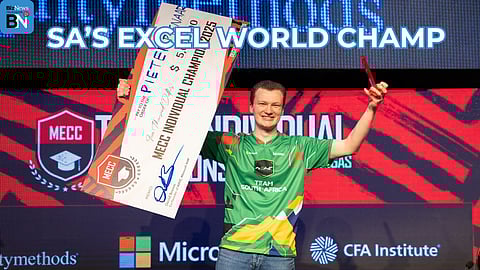
The UP student who turned Excel into a world title – Pieter Pienaar
When you’re filling in a Microsoft Excel spreadsheet, the idea of an international competition testing those skills is probably far from your mind. Yet Excel has become an esport, with competitors from around the world solving high‑pressure challenges on a major stage in Las Vegas. This year, University of Pretoria student Pieter Pienaar became the world champion in the 2025 Microsoft Excel Collegiate Challenge. Pienaar, who is currently completing his chartered accountant articles with PwC, told BizNews that for him Excel is a powerful problem‑solving tool, and that is exactly what the championship tested. When it comes to future developments in Excel, he strongly supports the role of AI because it democratises problem‑solving, provided companies act responsibly and ensure proper auditing. But, he adds, it should definitely not be used by the National Treasury to do your taxes.
Sign up for your early morning brew of the BizNews Insider to keep you up to speed with the content that matters. The newsletter will land in your inbox at 5:30am weekdays. Register here.
Support South Africa’s bastion of independent journalism, offering balanced insights on investments, business, and the political economy, by joining BizNews Premium. Register here.
If you prefer WhatsApp for updates, sign up to the BizNews channel here.
Watch here:
Listen here:
Edited transcript of the interview
Linda van Tilburg: (00:00)
Most of us think Excel is for filling in numbers on spreadsheets, but Excel is also an e-sport – yes, really. And a South African master’s student, Pieter from the University of Pretoria, has just become the world champion of the 2025 Microsoft Excel Collegiate Challenge. Well, we have Pieter in the studio with us to tell us more about that. Hi Pieter, welcome to.
Pieter Pienaar (00:26)
I’m well, thank you. It’s great to be here.
Linda van Tilburg: (00:30)
Well, congratulations! And for people who’ve never heard of it, what exactly is the Microsoft Excel Collegiate Challenge?
Pieter Pienaar (00:39)
It’s very difficult to explain to people what it is, because, as you said, Excel is usually just that tool everyone uses for things like tracking cash flow or making an invoice. As a student, I know we all use Excel to calculate how many marks we need in the final exam to pass. But the competition started as the Financial Modelling World Cup – essentially building spreadsheets and cash flows as quickly as possible. Then it evolved. They realised Excel is a fantastic problem-solving tool. Some of my engineering friends say they spend their entire day in Excel solving problems.
So, they started simulating games to test how well you can problem-solve using Excel. They love games, so they might give you a Battleship board with ships in starting positions and a list of guesses and ask who wins the game. You could do it by hand, but it’s much slower than writing a formula. You build the boards for each player, alternate guesses, check after each round whether someone has won, then drag the formula down. Excel gives the sequence of winners - A1, B1, A1 again - and you paste those answers into the website, which confirms everything is correct. That’s already fun.
They’ve simulated Battleship, darts, chess… Last year there was an incredibly difficult case about someone ice-skating and bouncing off the edges of the rink. You have 30 minutes to solve it, under pressure, on stage, in front of the world, live-streamed.
The guy and girl sitting either side of you are brilliant - the best in the world. You need to solve it faster and score higher than them. There’s real stress, but even at home on a Saturday, working through a case is incredible. It is a lot of fun.
Linda van Tilburg: (02:52.665)
Did you participate online or were you actually there in person?
Pieter Pienaar (02:56)
It starts online. This year there were 14,000 students from over 130 countries. Throughout the year there are monthly challenges, all online, and then in September or October there are two qualification rounds. Everyone competes online, and the top 64 are invited to Las Vegas.
I ranked 18th or 19th - There was a difficult case and didn’t do as well as I’d hoped, but I still qualified. I went to the US, made it through the semi-finals (finished 10th), and reached the finals. Fortunately, the final case played to my strengths, and I came first. So, there are online rounds leading to the in-person finals.
Linda van Tilburg: (03:44)
It’s amazing that this is treated as an e-sport. Is there commentary, live streaming? What’s the atmosphere like? Are there spectators in the hall?
Pieter Pienaar (03:55)
Yes, it was filled. There were easily 300 people, possibly more. We competed in the HyperX Arena at the Luxor in Las Vegas – a proper e-sports venue where people play competitive games. The stage has gaming PCs, each with a big screen in front showing what you’re doing, and a massive screen behind. Spectators sit in front and on a balcony above. They chant and cheer constantly.
The commentators are in a box up top - American commentators, so they really know how to hype things up. My supervisor joked that watching last year’s stream, you’d hear them say, “What is he doing? That’s fantastic! Look at that!” – and it sounds thrilling, but on screen it’s just someone typing a formula. The contrast is odd if you don’t know the context, but if you’ve played the cases and understand the formulas and the competitors, it really is exciting.
There are bonus questions only a six people can get, so strategy matters – you need those bonuses before others get them. Every five minutes the lowest-ranked player is eliminated. You watch your favourite struggling, perhaps from a reading error or a formula glitch, while time ticks down. Suddenly another player figures something out, submits answers, and leaps from 10th to 1st. The commentators rewind: “What did he just do?” It’s exciting.
It’s an e-sport in the same way competitive chess is – a battle of wits, live problem-solving, but with no fixed rules like chess. They can give you anything: a map of a forest with rivers and mountains affecting walking speed, multiple routes to evaluate. You have 30 minutes on stage to solve it.
You don’t have time to ponder the most elegant solution. You jump in because someone will be eliminated in five minutes. Everyone approaches it slightly differently, and the commentators analyse: “This player’s using a data table, but I’m not sure that will work for level four.”
It’s fascinating, though incredibly stressful on stage – lots of noise, and then you hear, “Let’s see what Pieter is doing,” knowing everyone is watching your screen while you struggle with something simple under pressure. And then your screen is up at the back and you just know everyone's looking at me thinking I'm an idiot because I'm struggling with the most simple thing because of the pressure. And now the world's looking at me.
Linda van Tilburg: (07:29)
So what was it like when you realised I'm not an idiot and I've actually won this?
Pieter Pienaar (07:34)
Actually, this year I was just grateful to reach the finals again. Everyone there is at the same level; tiny things can knock you out or put you in the lead. We received case notes ten minutes before the start – an overview. It was about Sudoku, with multiple puzzles on different sheets in different positions. I thought, “I’d normally use INDEX and OFFSET, which is two formulas but this layout…” I drew a blank. I told myself, ‘I’m already in the finals; even if I score zero, I’ll finish 12th – not bad.’ I folded the paper, calmed down, and accepted whatever happened.
I wouldn’t say I gave up, but I stopped stressing. On stage I put on noise-cancelling headphones and just started working. I forgot I was competing until about three minutes remained. I was expecting a tap on the shoulder any moment to say I’d been eliminated.
With three minutes left I solved a bonus no one else had attempted. I submitted, waited the ten-second validation delay. Through the headphones I heard the crowd react. I looked up – they were showing my screen – and saw the leaderboard: I was first. For the first time I realised I was properly in contention. Those last three minutes were intensely stressful, but I solved another section, reached 1,000 points, and the timer ended.
Everyone came over, shook my hand, congratulated me. I kept staring at the leaderboard, reading my name, thinking, “Is that spelt right? Is that really me?” It’s like when you’re unsure in an exam whether 2 + 5 is 7, so you check on a calculator. The pressure can affect anyone, no matter how good you are at home. I think staying calm made the difference.
If we ran the same case again, Benjamin Weber or David from Austria, or Jacob from the US – all brilliant – might have won on another day. I’m just grateful it was me this time, and that the South African flag was at the top, where it belongs in my view. The key is staying calm, breaking the big problem into tiny steps, solving each with simple formulas, then combining them.
Linda van Tilburg: (11:09)
Tell us a bit more about yourself. You’re doing a master’s at the University of Pretoria – where did this interest in Excel come from?
Pieter Pienaar (11:24)
I come from a family of engineers, so problem-solving and making things is fun. We have 3D printers, lathes, that sort of thing. Oddly, I chose to study accounting and train as a chartered accountant because I loved it at school. In matric I thought I could teach myself engineering or programming if I wanted to start a business – I wrote my first app in Grade 5 – but you need formal qualifications to become a CA. I wanted the business and legal knowledge I didn’t have.
Halfway through the degree I fell in love with chartered accounting. A former CA from TUKS, Renier Wessels, heard about the competition, came to UP, and offered to coach interested students. I was in second year, saw the email, and signed up – nothing to lose. He showed us a Battleship case; I solved it perhaps 40 times, trying different approaches. I really started loving it, the programming-like efficiency challenge, and it fitted perfectly with my enjoyment of problem-solving.
Practising the same case repeatedly taught me so much that by the end of the year I qualified for the finals in the US for the first time and finished 12th – I was delighted. I completed my BCom two years ago, my postgraduate diploma last year, and this year started articles at PwC. However, I applied for and was accepted as an academic trainee, so instead of auditing I returned to university to lecture second- and third-year business acumen modules, heavy on Excel. I started an Excel club at UP to involve more students – I want more South Africans at the finals.
Seeing how students solve problems. Someone would say, “I’m no good at Excel,” I’d ask how they’d tackle it, and they’d suggest an elegant solution I’d never considered. I probably learned more from them than they did from me, and that helped enormously in the finals.
To anyone hesitant because they “don’t know Excel” or “aren’t smart enough,” I say: it’s a problem-solving competition; we can all solve problems. Excel is simply the tool.
Linda van Tilburg: (15:07)
After this, you’ll complete your CA training – and perhaps start your own company one day?
Pieter Pienaar (15:12)
Hopefully. I don’t know where I’ll be in two years, but I’m positioning myself to be ready for opportunities. Next year, 5 January, I start properly at PwC for two years of auditing articles – I’m looking forward to it, and the Excel skills will certainly help.
This year I also did a lot of AI development, building apps for the university under Prof. Madeleine Stiglingh and Andrew van der Burg. The combination of problem-solving, AI work, and great teamwork led to me winning the SAICA Trainee Trailblazer Disruptive Innovator of the Year award – another “I can’t believe it” moment, but very much a team achievement. I just try to walk in and solve problems, and my arguments is, if you can do that, how can you fail?
Linda van Tilburg: (16:28)
That sounds amazing. On the subject of AI, how do you see Excel and AI working together?
Pieter Pienaar (16:42.24)
Microsoft is working very hard on this. Microsoft Copilot is now pushing strongly into Excel, and although it’s controversial, I’m actually very much in favour of putting AI into Excel. My argument — especially with my students — is this: when we’re solving something complex, I tell them, “Write in English what you want to happen.” Break the problem up, give me the steps, but write it in plain English.
And write it as clearly as possible. We even do an exercise where I stand in front of them with a piece of paper and say, “Instruct me on how to fold a paper aeroplane.” But I deliberately misunderstand them. They’ll say, “Fold the paper in half,” and I’ll fold it in some strange way. I’ll say, “But you said in half — you weren’t specific.” When you’re explaining something to someone, you must always be specific. So I tell them: break the problem down in English. Be as specific as you can.
If you do that, I can think of the formula. You might say, “I want a list of all the names that appear more than once.” Okay — that I can do. I’ll write the formula, and it will display exactly that. But you did the problemsolving. Yes, you might not know the formulas, but you already did the difficult part.
Now, with AI in Excel, that’s exactly where the world is going. You don’t necessarily need to know the formula. If you can say, “I need to solve this problem; let’s break it into smaller steps,” Copilot can take that. You can type into Excel, “Write a formula that gives me X, Y, Z,” and it will write the formula. There will still be a need for someone to look at it and doublecheck it, but I think it enables the layperson — who doesn’t have time to learn every Excel function and edge case — to solve more problems. And ultimately, that’s what we need.
So I’m very pro this. It might be dangerous; there might be hallucinations that break spreadsheets. I don’t know how I’d feel if the National Treasury did that with our taxes and an AI made an accidental mistake. But as long as big companies are careful, and things are audited and verified, I think it democratises problemsolving — which is absolutely fantastic.
