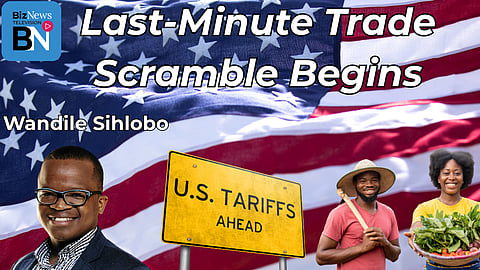
The future of many South African farmers hangs in the balance today with 30% export tariffs to the US set to take effect tomorrow. Wandile Sihlobo, the Chief Economist of the Agricultural Business Chamber of South Africa (Agbiz) - who has been involved in some of the trade deal preparations - says: “I would say that the South African authorities have done a fair share of their work on improving the offering that they had made at the end of June in Angola. The key thing then is whether there will be sufficient time to provide enough thinking as to what is being put on the table, given that every country in the world literally is racing to have a conversation with the US authorities.” Meanwhile, Sihlobo urges a change in approach in how South Africa engages with the world.” I think…we must embrace free trade agreements.” He also gives an update on the Foot-and-Mouth disease outbreak that has taken South African cattle farmers out of the export market for a particular period. However, he celebrates the excellent grain harvest up North where it’s up double digit from last year. “We are looking at over 18 million tons of grain”. He also predicts a year of recovery for wheat, barley, and canola.Sign up for your early morning brew of the BizNews Insider to keep you up to speed with the content that matters. The newsletter will land in your inbox at 5:30am weekdays. Register here.Support South Africa’s bastion of independent journalism, offering balanced insights on investments, business, and the political economy, by joining BizNews Premium. Register here.If you prefer WhatsApp for updates, sign up to the BizNews channel here..Watch here.Listen here.Edited transcript of the interview.Chris Steyn (00:01.536)The future of many South African farmers hang in the balance today, with 30 % export tariffs set to take effect tomorrow. We speak to Wandile Sihlobo, the Chief Economist of the Agricultural Business Chamber of South Africa. Welcome, Sir. Wandile Sihlobo (00:19.032)Thanks for having me on Chris. Chris Steyn (00:21.738)So is there still any possibility of a last minute deal, a last minute trade deal to avert these tariffs? Wandile Sihlobo (00:31.086)I think, Chris, the first thing I could say is that observing what has been happening across the world, the US in its engagement with many other countries, is that as South Africa, we are not unique in this position of heightened uncertainty that we are in. We have already seen that the deals with Japan had higher tariffs around 20 percent, the EU around 15 percent, Indonesia and many others. The point is that the US is levelling relatively higher tariffs than one would have expected in an environment where they say they have the trade deal. But, of course, in a South African case, their point about the US remains at the core, which is that they are an important trading partner, but also in terms of investment and engagement, it's a country that we want to continue having a much more better relationship with. As to where we stand at this moment, I mean, my work at Agbiz and my work at government, I have been involved in some of these preparations, I would say that the South African authorities have done a fair share of their work on improving the offering that they had made at the end of June in Angola. And you will know that even from the DTIC statement that came out, that that involves the agricultural component of what the U.S. demanded in terms of poultry and the other aspects. It also does involve some work on the mining and the auto industry amongst the other things. The key thing then is whether there will be sufficient time to provide enough thinking as to what is being put on the table, given that every country in the world literally is racing to have a conversation with the US authorities. So on the backdrop of that, I would say we remain at a point of heightened uncertainty in South Africa at this moment. And agriculture, which is the sector that I work in, is literally also in that space because you and I have talked in the past about the importance of the US for citrus, but it's also as equally important for the table grapes, for wine, for ostrich, for nuts, amongst other products, which have a much more higher exposure in the US. Although when you're looking at a broader level, the US is about 4% of our agricultural exports, but it still has a heavy exposure to certain commodities… Wandile Sihlobo (02:49.078)…in certain regions like KZN, Western Cape and Mpumalanga amongst others. Chris Steyn (02:54.486)Now with these concerns around tariffs and looming job losses, should the agricultural sector still be regarded as an area of potential growth medium and long term? Wandile Sihlobo (03:09.122)I mean, the South African agricultural sector, Chris, is one of the sectors that I'm very excited about its prospects. Yes, the US is important. 4% market share in our exports and may grow if we get a better deal. But I would say whatever is the tension is and wherever we land in terms of the tariffs with the US, that doesn't change the fundamental aspects of where the sector is going. We remain of the view that the gross value added of the South African agricultural sector can still expand by plus 30%. We also think that there will still be close to a million jobs in agriculture and its value chain that can be created. But there are prerequisites on this, Chris, and I don't want to pretend as if everything else hinges on Trump, because we ourselves as South Africa, there are a number of things that we could have corrected to unlock growth in agriculture, but we haven't been able to do that. Starting off with the municipalities and ensuring that they are effective in service delivery, in water, in issues of security, issues of improving the road networks. Those are all of the key things that make the environment vibrant, as well as conducive for agribusinesses, small and medium scale and large scale farmers. But it also makes those towns to be effective in terms of agritourism, which is one of the things we want to continue to promote, where South Africans visits the agricultural activities, and then they can be able to see what happens at the farms. They can explore the hospitality in various small towns of South Africa, which is part and parcel of this tourism on a regional basis of South Africa. But that won't happen without municipalities. The second aspect is around the rule of law, as well as dealing with the criminality and the crime in general in South Africa, but more so in small towns. That's something that is within our side. And I would say beyond that, there are aspects that you and I have talked about related to land release that the State can do and make sure that they strengthen the title deeds of those new beneficiaries. They release their over 2 million hectares that they hold. And I think in addition then to that, it brings again us back to the aspect of trade. Not only now with the US, Wandile Sihlobo (05:28.376)…but thinking about the diversification to other markets. Those are all of the important levers. And I would say, Chris, in a much more optimistic point, at the end of July, finally, we got to hear the news from Transnet. And they were covered in some of the media platform that even at the ports, things are starting to improve, which means that on facilitating the exports and logistics, whatever is happening there, as well as the collaboration with private sector, it needs to continue because that is important. These are some of the things that are within our control. Ports, release of land, partnerships, improving municipality efficiencies and water rights and many other things. In addition to then the trade related aspects which will power the growth of our sector. Chris Steyn (06:13.996)Now with world trading system changing and South Africa falling from favour, do we have a capacity to unlock the necessary trade diversification that you would like to see? Wandile Sihlobo (06:30.318)I would say, Chris, and I was rushing speaking over you, sorry for that, but the key point was that we are not falling out of favour just only as South Africa. But you are right in your observation that the world in general, we are no longer in that sense of embrace globalisation. There is a force of fragmentation that is there. And I think then that you hit the nail on the head of asking the question as to whether as South Africa, do we still have the capacity to then open up these export markets that I'm talking about in other regions. Because you and I know that we started in South African agricultural sector gaining momentum from the early 2000s. If you go back to year 2001, 2002, South Africa's agricultural exports were at $2 billion US dollars. You go to 2024, they were at $13.7 billion. The progress that we have gained was through opening up many export markets, the EU, through…the SADC, and many other engagements that we have with the Asian countries to an extent that if you look at the $13.7 billion of our agriculture exports and say, where are these exports going to? You realise that almost half to the African continent, 20%, 19% somewhere there it's the EU. Then you have Asia in the Middle East, about 24%. Then you have US, 4%, 2 % the rest of the Americas, which shows you then that we do have a certain level of diversification where we open these markets in those early years of globalisation. But now the world is taking an inward approach. And as South Africa, we want to go out there and say, hey, we have something for you to sell. And I think that's where then the environment becomes much more difficult. And as far as the capacity, I think, Chris, we need now to move to a level where it's no longer just the private sector and the various businesses sitting on the side and saying, government must be doing this. I think at least on a knowledge basis, the private sector, the academia and many research organisations and perhaps maybe the well-off South Africans should be supporting the research organisations… Wandile Sihlobo (08:46.222)…in various regions of the country to ensure that they go out and do work, especially funding the work that is on trade related aspects so that all of that research output can better guide the policy makers, better guide the various departments. Because in my assessment of it, I would say that there is a gap both on the human capital side, as well as what we can do with speed, which is where I think we need to leverage in all of this. And we are a country that is well organised. There's a formal business grouping. You yourselves at BizNews, you run this conference with business leaders, where I think the aspects related to trade, those are things we should be discussing and thinking up about the ideas. But to your point, I think there is a gap on the knowledge side and the skill side that all of us needs to play to support their policymakers so that the choices that are getting made, they are appropriate. But the responsibility also lies on the policymaker to not only view any insight that is coming from outside as lobbying and all of those things. Sometimes people care about the country just like you do if you are in government. Therefore, when they say, look into China, look into Saudi Arabia, look into Canada, those are things that you should entertain with an open mind and really look and why they say focus on those markets. And perhaps if you can bring the men to assist, you do that. And I think that collaborative spirit is what is needed right now as South Africa embarks on this new path. And I would close that point, Chris, by saying we also need to change an approach in terms of how we have been engaging with the world. I think as South Africa now, and perhaps this is a point for policymakers, that we must embrace free trade agreements. It's no longer going to be like in the past where people knew the painful history of South Africa. They still know it now. But at the time, they were thinking really sympathetic about us and saying they want to embrace us, they want us to integrate with the world again. But right now, I think we are at a point where we need to say, okay, we want ABC, but we can also give you this because the trade-offs is the game of today..Read more:.BN Briefing: Trump snubs SA G20; Dawie Roodt on SA’s 30% Tariffs expected to hit tomorrow; R800m tender scandal.Chris Steyn (10:50.144)Meanwhile, can you please give us an update on the Foot-and-Mouth disease outbreak and its possible consequences? Wandile Sihlobo (10:58.786)The Foot-and-Mouth disease, Chris, to folks that haven't been following a lot the agricultural sector is a disease that typically affect cattle and even small stock sheep and goats. They can get it at certain times. We pay attention to it in South Africa because if you think about the South African farming economy, almost half of our farming economy is livestock and poultry. So when there is any disease that threatens that, we find that our entire farming economy to a certain extent is threatened. And in South Africa, we have been struggling with animal diseases. And again, not to be defensive or patriotic, but animal diseases have been an issue globally. I mean, look at what has been happening in the United States. They had a Bird Flu and that Bird Flu crossed to a dairy cattle from dairy, it moved to people. And we've seen cases of African Swine Fever in pigs in China in the past few years, which led to devastation. We've seen avian influenza in South America and Europe. So there's an issue of animal diseases in general, and it's happening at a faster pace. But with Foot-and-Mouth disease in South Africa, it's something that we have been struggling with a lot. In the years before 2022, 23, that was for the first time where about six of our nine provinces were affected by this Foot-and-Mouth disease. And that led to Minister then…who is now the Speaker of the House, saying, hey, let's put together some scientists, some veterinary scientists, some agriculturalists to say what should be the solution. And they came up with this report, which had a range of recommendation. And Chris, disappointingly, in a classic South African way, we did not go and fully implement all of those recommendations that were there… But I think this time around, we need to start looking at those report as well as what the new Minister of Agriculture, Mr. John Steenhuisen has been saying. He did an excellent Indaba in the past few weeks where he brought everyone else in the room and said, let's think about this disease. What should we be doing? Building on that work of Ms …. Wandile Sihlobo (13:13.058)And I think that's the instrument or the path that we should be taking. But at the moment as to where the scale of this is, it's not affecting each and every cattle and each and every farm. It's in a few farms, they've all been quarantined and the meat in South Africa is safe for consumption. But the impact of it though does mean that the South African cattle farmers are out of the export market for a particular period which is devastating because we are a country that has been building our footprint on the exports to an extent that now we were seeing our exports creeping under 40,000 tons in some years, crossing that figure. And we're thinking we are building our exports in them, especially in the Middle Eastern, the Asian and the African continent. And now we are being hit by that. The financials of it though, that's something that is going to be very devastating to farmers because at the end of the day, the Foot-and-Mouth doesn't kill the cattle, but you need to vaccinate them and they are kept for a particular period without being slaughtered and you have to continuously feed them. That increases your cost as a farmer. For us as consumers, because we are closed off on the export markets, we anticipate that red meat prices may come down and benefit us. So it's this environment where we could find a much more affordable red meat and go out for a braai. But if you are a farmer. you will be in an environment that is quite challenging. That's what we've been grappling with when we think about this Foot-and-Mouth disease, Chris. Chris Steyn (14:47.552)Meanwhile, how is the grain harvest looking up North, sir? Wandile Sihlobo (14:54.118)I would say, Chris, even just before commenting on this grain aspect, the one important thought also on dealing with the Food-and-Mouth disease. I mean, it's not that it's happening to us. We are these unfortunate people only. I think that there's a responsibility between farmers as well as the government and South Africans. Biosecurity is a job of everyone in terms of ensuring that we follow all protocols. And I do think, Chris, for many South Africans in small towns in rural South Africa, former Homelands, we should make sure that we look into the movement of animals and we put all measures and not have animals roaming around because that passes certain diseases. And I think the olden days where we used to have fencing by the roads, fencing to ensure where animals graze, that's something that needs to be done. And the people that are responsible for that is the Department of Public Works. And I think the Department of Public Works should do something collaboratively with the Department of Agriculture and the police to ensure that we enforce all of those regulations. Beyond that, there is something to be said about vaccination because South Africa has lost its vaccine manufacturing capacity. Part and parcel of these State Capture issues over the past few years. We are now this country that boasts about being the most food secure country in the sub Saharan Africa region the most advanced agriculture in Africa, but we can’t produce the vaccine for Foot-and-Mouth disease and some of the other stuff that we will need. And part and parcel of this is not that we don't have talent, we don't have facilities, but this needs to be improved because they took a hit in the bad years of the past few years. And I think this is the work that even Minister John Steenhuisen has signaled on. And I think he has to be supported on those efforts because we need that vaccine manufacturing. Once that is done, we do need as a country to decide if we want to vaccinate for Foot-and-Mouth disease in general. And I think that's an important aspect that we need to think about because livestock and poultry is about half of our farming economy. Quickly though, in thinking about what's going on up North, we have had an excellent year if you take a step away from the livestock issues. If you think about our grain harvest, it's up double digit from last year. We are looking at over 18 million tons of grain… Wandile Sihlobo (17:11.074)…which means then in terms of food price inflation, if we see the meat prices coming down and also we have this ample grain harvest, and of course I'm talking about 18 million tons, you include their soybeans, maize, sunflower and all of the other small grains. We've benefited from the excellent grains and surprisingly, I mean, even if you look at countries like Zimbabwe, they've had an excellent year, although they will still need a bit of imports and we will supply them with that. And Zambia is also having a great grain harvest. And as a country, when we think about maize, though, the stable grain, we will have enough, about 15 million tons. We need about 12 million tons for us. And then that means that we will remain a net exporter in that space. So all in all, for South Africans, they can see this year as going into next year would reasonably subdued or moderate food price inflation because of the better grain harvest as well as the meat. But of course, there's a lag between the farm level as well as you see these things in the retail chain because there's a processing and logistics and the other costs that as well as the timeframe that one has to account to with thinking about these things. Chris Steyn (18:21.846)To end off on another positive note, we've had excellent rains in the Western Cape. What do you predict for our farming sector? Wandile Sihlobo (18:31.116)I mean, down there in the Western Cape, I know that the guys won't be getting rich. You won't see them going out there and buying bakkies because it's not as good as that. But in terms of the output, it is a good year, Chris, you are right. We've received excellent rain, but the unfortunate thing that we had for farmers that are in Canola, they struggled a lot in part of the Southern Cape with the issue of the snails to an extent that they had to make sure that they apply chemicals on removing those and then replant again, sometimes replanted twice. So that increased the cost when you are thinking about the farmers. Because remember, in the agricultural sector, you have various aspects. Fertiliser makes up about 35% of your input costs. Fuel, as you are driving around, makes up about 13% of your input costs in grain farming. And all of these are things that we import. So that will put a strain on the farmers. But in terms of the output, we see farmers having increased the area they plant. They've planted around 824,000 hectares for winter crop. That's the Western Cape and the other parts of the country. But the Western Cape produces about two thirds of our winter crops. So wheat, barley, Canola and oats. And I think that we are looking into a year which will be a recovery for wheat, will be a recovery for barley, Canola. I can't wait to drive down in the Southern Cape and see the nice Canola flower. So a fairly good year and a fairly good note to end it on, aside from some of the difficulties and the uncertainties of trade and the animal diseases crisis. Chris Steyn (20:02.454)Thank you. That was Mr. Wandile Sihlobo, the Chief Economist of the Agricultural Business Chamber of South Africa speaking to Biznews. And I'm Chris Steyn. Thank you, Sir. Wandile Sihlobo (20:14.243)Thank you.