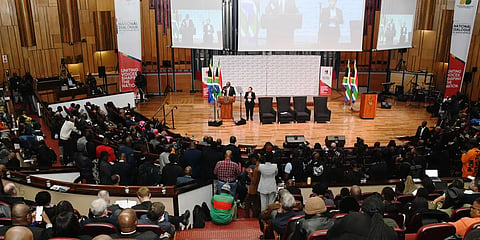
Key topics:De Klerk Foundation withdraws from first National Dialogue meeting due to disorganization.Foundation reaffirms commitment to Dialogue, despite frustrations with process. Dialogue sparks debate on BEE, electoral reform, and government accountability..Sign up for your early morning brew of the BizNews Insider to keep you up to speed with the content that matters. The newsletter will land in your inbox at 5:30am weekdays. Register here.Support South Africa’s bastion of independent journalism, offering balanced insights on investments, business, and the political economy, by joining BizNews Premium. Register here.If you prefer WhatsApp for updates, sign up to the BizNews channel here..By John Matisonn.The FW de Klerk Foundation remains committed to the National Dialogue despite its “ramshackle” organisation and its first “shambolic” meeting, from which it withdrew along with several legacy foundations. While these concerns led it to withdraw from the first meeting, a De Klerk foundation board meeting on Thursday night decided that the foundation remains committed to the National Dialogue process. Other institutions that boycotted the first meeting are considering their options.The De Klerk Foundation concluded that the National Dialogue process remains consistent with the late president’s February 2 1990 speech in which he said that “the table is laid for sensible leaders to begin talking about a new dispensation, to reach an understanding by way of dialogue and discussion.” It has promised to approach the next phase “with an open mind and maturity”, but its role remains unclear. The Eminent Persons’ Group has asked those that withdrew to suspend judgement till the end of the month so they can prove that they are “not captured” by government. But foundations are still waiting for the Eminent Persons’ Group to indicate what role they will play. Some non-ANC organisations are considering taking party to bring a vote on scrapping BEE and bringing back electoral reform along the lines of the Slabbert Commission, which would elect representatives in constituencies. The ANC has stood firm against both these reforms, but some civil society leaders hope that the public will back them, and that a vote against the ANC at the Dialogue could put meaningful pressure on parliament and government.Despite the foundation’s openness to continuing, the foundation’s Ismail Joosub, manager, constitutional advancement programmes, was unsparing in his description of months of frustration with the process.“It was shambolic, ramshackle, not just the two days, but the lead up,” said Joosub. “Three weeks before, the president announced it would start on August 15, without consultation. We gave a list of names for the Eminent Persons’ Group, but it was also announced with no consultation.” Joosub said the budget, once it was given, was R452m. “On July 11, we were promised that funding would be with Nedlac, financing to be in Nedlac, but it wasn’t. We believed this could put us in violation of the timelines required in the Public Finance Management Act. Then R25m in but we were not told. We asked for a postponement and were refused.”Joosub described similar chaos in organising the event.“Some announced speakers were not invited. Some got accommodation but no transport, others got transport arranged but no accommodation. It just looked like a political photoshoot opportunity.Fears that government leaders were treating it like an ANC election event, as an “ANC listening campaign”, were heightened when Deputy President Paul Mashatile responded to criticism at a meeting by saying “the ANC has heard you.” The Eminent Person’s Group appointed by President Cyril Ramaphosa has asked the foundations to suspend judgement until the end of this month to give them time to show they are “not captured.”Speeches by young South Africans at the first meeting were withering in their criticism of the government.“It’s no secret that the government is ineffective and corrupt,” one young township resident said from the floor. “We raised some of these very issues, and their only response is that we need ‘unity’. How is unity going to solve unemployment, inequality? We need an effective government. If there is failure, they must be replaced. The youth of June 16 did not fight for this.”Joosub said his foundation had three aims for the Dialogue: a new social compact, a 30 year plan of action following up the National Development Plan, and systemic change such as electoral reform.The Dialogue has already impacted social media and one profession -- stand-up comics. Many highlight the President’s speech in which he said the key questions to be asked were all issues where the government has failed, like “Why is unemployment rising?”