
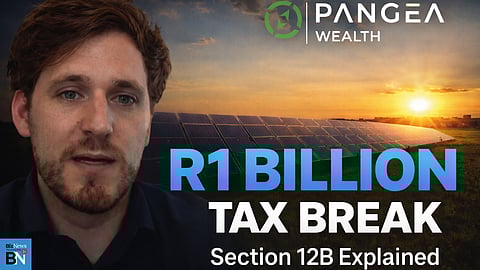
Pangea Wealth unlocks R1bn of Section 12B tax deductions for HNWs
In South Africa, high earners face a 45% marginal rate with limited deductions, making Section 12B of the Income Tax Act a powerful tool to ease the tax burden while investing in renewable energy. In an interview with Biznews, Mitchel Fieldgate, wealth manager and alternative investment lead at Pangea Wealth, revealed they have facilitated R1 billion in deductions over the last two years. He noted that while this provides relief for high earners, it has also mobilised billions into commercial solar projects, reducing reliance on Eskom and alleviated load shedding. Fieldgate explained who might not benefit from the tax relief, clarified that it is not a tax loophole, and stressed that the 12B opportunities are not a one-size-fits-all solution. He suggested the government introduce similar tax breaks for repairing other infrastructure, such as water systems or roads, “because it mobilises money and there’s no leakage.”
Sign up for your early morning brew of the BizNews Insider to keep you up to speed with the content that matters. The newsletter will land in your inbox at 5:30am weekdays. Register here.
Support South Africa’s bastion of independent journalism, offering balanced insights on investments, business, and the political economy, by joining BizNews Premium. Register here.
If you prefer WhatsApp for updates, sign up to the BizNews channel here.
Watch here
Listen here
Edited transcript of the interview
Linda van Tilburg (00:01)
South Africa's top earners are being squeezed by a 45% marginal tax rate. That's similar to levels in Germany, the UK, France, China and Australia. But unlike many of those countries, South Africa offers far fewer deductions and allowances, which makes that 45% feel a lot more punishing. As a result, high earners have been looking for legitimate ways to reduce their tax burden. Today we have Mitchell Fieldgate, wealth manager and alternative investment lead at Pangea Wealth, to explain how South Africa's renewable energy tax incentive, Section 12B, has become such a powerful tool for high-income earners.
Mitchell, let's start with the basics: in simple terms, what is Section 12B and why has it become so relevant?
Mitchell Fieldgate (01:02)
Section 12B is a government tax incentive designed to encourage investment in renewable energy. It was introduced in 2016 and got a significant boost in 2023. It's basically an incentive like you see in many countries around the world.
What's been amazing is the outcome when government dangles a proper tax incentive in front of people. I think it's been a big reason why load-shedding is largely a thing of the past, there's been an absolute outpouring of capital into solar projects. South Africa has some of the best sunshine in the world, especially in the Northern Cape and North West, but we historically had hardly any solar. Under Section 12B you get a 100% deduction in the year of investment. Many of these funds now allow you to gear up the deduction with debt. For example, a client might put in R1 million of equity, borrow another R1 million, deploy R2 million worth of solar, and claim a R2 million deduction.
High-income earners in South Africa are quite desperate to reduce their taxable income. They're understandably frustrated when they earn R10 million and hand over R4.5 million to SARS. Then on top of that, they still pay for private security because the police aren't delivering, private medical aid because public healthcare isn't reliable, and decent schooling for their kids. You pay this huge tax bill but don't get the benefits you'd expect in return.
So, this renewable energy incentive feels like a much better use of money, going straight into profitable energy projects instead of to SARS where there's often leakage and inefficiency. One colleague even joked they should create a similar incentive for investing in potholes, roads or bridges. That way private money would flow directly to fixing things with far less leakage.
Linda van Tilburg (04:16)
If a client approaches you saying, “I've heard about this, can you explain how it works and what services you provide?”, how would you respond?
Mitchell Fieldgate (04:25)
These 12B opportunities aren't one-size-fits-all, so we work closely with each client. To my knowledge, no other wealth management firm in South Africa has raised as much capital through Section 12B as Pangea Wealth, we've facilitated over a billion rand in deductions in just the last two years.
We'd sit with the client, understand their taxable income, and then draw from our suite of due-diligence investments. Just like on the traditional wealth management side where we place clients with Allan Gray or BlackRock without running the funds ourselves, we do the same here. We've researched dozens of 12B options and narrowed it down to two or three that we're very bullish on.
These structures are complicated, legal agreements, diversification, project quality, off-taker solvency, power purchase agreements. We'd much rather have a solid agreement with a Makro than a small local shop. We've spent a lot of time on due diligence to select best-of-breed options.
We also tailor it to the client's liquidity needs, expected refund timing, cash flow, risk tolerance, whether it's a lower-risk or higher-risk option. We use a bespoke cash-flow simulation model to backward-engineer what investment size delivers the maximum tax saving.
It's nuanced, and we make sure investors fully understand the risks. The last thing we want is people investing in things they don't grasp. Some 12B funds are just focused on raising as much capital as possible, so their marketing can downplay risks or ignore competing options. Using an independent advisor like Pangea adds real value, that's a big reason we've raised the volumes we have.
Linda van Tilburg (07:47)
Are there people who should not invest in these?
Mitchell Fieldgate (07:53)
Yes, definitely. When you get the deduction you either get a refund (if you've already paid PAYE) or a reduced assessment. For most, around 90%, it's straightforward, but SARS can be unpredictable: one client gets a R10 million refund in a day, another waits four months for R250 000.
Low-income earners shouldn't bother, the tax benefit is the main upside, so below about R1.5 million taxable income it usually doesn't make sense.
Also avoid it if you have complicated structures, aggressive tax planning, paying a non-working spouse a salary, or heavy company-level planning. SARS will scrutinise these investments closely, and you can't invest through a company. I've seen deals fall apart because partners in a business wouldn't all participate.
The ideal clients are simple high-income professionals with a big personal tax bill, whether from salary, capital gains, or a once-off event. For the right person it's very powerful, though not life-changing for everyone. If you've got R1 million to pay SARS this February, you could invest it instead, get the deduction, and create a new income stream. But it's not one-size-fits-all, and there are risks, which is why independent advice matters.
Linda van Tilburg (10:27)
What does an investor eventually own in a typical 12B structure?
Mitchell Fieldgate (10:34)
Essentially, solar assets. You join a partnership that purchases the equipment and deploys it on off-taker sites, often big retailers like Makro. The off taker might need R20 millionsof solar but can't fund it upfront, so the fund deploys it. In return, they agree to buy the electricity produced over 10–20 years at predictable escalations, say 3–5% a year, much better than Eskom's volatile increases.
The off taker gets cheaper, more reliable power. The fund gets an income-generating asset plus the big deduction. We prefer funds run by experienced solar operators, 15–20 years in the game, not newcomers who only appeared when the incentive was announced.
Margins have tightened: panels are cheaper, load-shedding is gone, off-takers are less desperate and negotiate harder. You don't want inexperienced players in this environment. At the end of the day, investors own physical assets because that's what qualifies for the deduction. We’re very selective about partners to ensure projects get deployed properly and qualify, we've seen cases where people expected a big refund but only got a fraction because something went wrong.
Linda van Tilburg (14:23)
Do people ask, “Is this a loophole? Are you sure it's legal?”
Mitchell Fieldgate (14:32)
All the time, and it's a fair question. As the alternative investments lead, my biggest fear is promising clients a deduction that doesn't materialise. We have family, friends and clients with tens or hundreds of millions at stake. If it went wrong, I'd probably have to emigrate!
But it's not a loophole. Government could scrap it tomorrow if they wanted. Solar incentives exist worldwide, some far more generous. The intention is clear: get private capital into renewables. Companies get reliable green power, the country benefits, load-shedding eases, GDP grows. It's one area where the ANC can rightly claim progress.
We check every year whether it's still in the Act, it remains for now. No client of ours has had a deduction outright rejected (though we sometimes object or appeal). Even with SARS teething issues, we get outcomes, and we help clients and their accountants with documentation and follow-ups.
Linda van Tilburg (16:56)
How should Section 12B fit into someone's broader long-term financial plan?
Mitchell Fieldgate (17:03)
The dream scenario is an older client who's sold a business and faces a big tax hit, say R10 million to SARS. Instead of paying it, they invest R10 million in 12B, get the deduction, and create an annuity income, maybe R600 000 a year, taxed at a lower rate because they're no longer earning a salary.
We've set up income streams fully funded by tax savings north of R2 million a year, passive income equivalent to what a managing director or CA might earn. The rich effectively get richer.
For high-income PAYE earners especially, options to lower tax are limited, RAs cap at R350 000, while 12B is uncapped. Many clients are excited once they see the certainty of the saving. This is my fourth year doing it, so we know it works.
But each year requires new projects, you can't claim on the same assets twice, and returns are compressing as off-takers negotiate harder. Funds fill up quickly because project capacity is limited. Last year we had to turn away R50 million in the final weeks. If your listeners have a big February tax bill and want help navigating this, there's still limited space via Pangea, reach out soon.
Linda van Tilburg (21:24)
It sounds like we need something similar for water infrastructure now.
Mitchell Fieldgate (21:28)
Absolutely. They did try one for electric vehicles, 150% deduction if you manufacture them, but competing with China feels high-risk compared to solar. You're right though, if government wants to mobilise private capital for roads, water, bridges, these incentives work brilliantly with minimal leakage. When they align incentives properly, it's phenomenal. I really hope we see more of them.
