
Strong fundamentals continue to power growth for Fortress Real Estate Investments
Watch CEO Steven Brown and CFO Ian Vorster talk through Fortress's FY2026 results in the video above — here's the story behind the numbers.
It's been, in Steven Brown's words, “a very strong set of results” for Fortress this year. For the year ended 30 June 2026, distributable earnings rose 14,2% to R2,234 billion, ahead of the company's guidance — a result achieved despite rising energy prices, higher interest rates and a challenging macroeconomic backdrop.
“What's been most pleasing to see is the buoyancy in the South African real estate market,” Brown says in the video. “It's really been quite something to see, especially given that the macro growth has been quite weak.” That buoyancy showed up clearly across Fortress's core portfolios: the South African logistics portfolio — now almost R20 billion in value, having doubled in size over the past six years — continues to hold very low vacancies, and the core South African retail portfolio remains low too. On a like-for-like basis, the South African logistics portfolio delivered NOI growth of 8,4%, with retail close behind at 7,3%.
Group-wide, like-for-like NOI growth came in at 6,8%, with net asset value also climbing — SA REIT NAV per share rose 9,2% and tangible NAV per share rose 9,4%. “That NOI growth has also lifted valuations, which is one of the key underpins of a stronger balance sheet at 30 June,” says Ian Vorster, Fortress's CFO. That stronger balance sheet was helped along by a R1,35 billion equity raise, completed in an accelerated bookbuild late in the financial year. “It's been something we haven't been able to do in just over a decade,” Brown says of returning to shareholders for fresh capital. “So again, thanks to all our shareholders for their support and for entrusting us with that money.”
The capital raise, together with continued earnings growth, brought Fortress's loan-to-value ratio down from 39,1% to 34,0% — on the lower end of the company's targeted range. Vorster also points to unusually favourable conditions in the debt capital markets: “We've seen unprecedented tightening of pricing... Fortress was able to raise 2,7 billion rand in tenors of three, five and seven years at really compelling pricing,” he says — including South Africa's first ZARONIA-linked note issued by a listed property company.
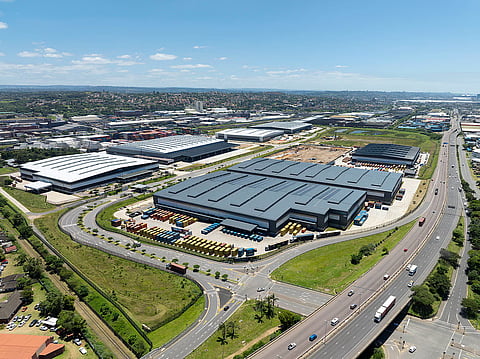
That capital is being put to work in the logistics pipeline. “We have some very exciting pipeline projects,” Brown says. Since 2019, Fortress has developed between 100 000m² and 150 000m² of logistics space a year, largely funded — in what has been a capital-constrained market — by selling older, non-core assets. “We've managed to more than double our logistics portfolio just by selling older assets,” he explains. Looking ahead, the company's South African logistics pipeline stands at approximately 286 000m² of undeveloped GLA, including the newly acquired Eastport North site — reducing to around 170 000m² once pre-let deals there are concluded. Brown says growing demand around nodes like the Western Cape and an increasingly efficient Durban port gives Fortress “the confidence to grow that portfolio of pipeline projects, and we will do so in a very disciplined, capital-light manner.”

On the retail side, the standout move of the year was the acquisition of a controlling stake in Balfour Mall — “probably a bit of an institution” for Johannesburg residents, Brown says, “but I think it perhaps lost its way a little.” Fortress's retail team is now applying its in-house development, asset management and leasing expertise to change the asset's trajectory, part of a broader shift toward redeveloping underperforming retail assets rather than building new ones.
Sustainability featured prominently too. At 30 June 2026, Fortress had 121 operational solar PV plants (with 133 planned by June 2027) and installed capacity of 40,11MWac, alongside 1,95MWh of battery storage capacity — set to more than triple to 7,05MWh once approved installations are commissioned. “What that gives us, looking forward, is a much more sustainable portfolio,” Brown says, “and ultimately the financial benefit is a lower occupancy cost for our tenants... and happier tenants, which is certainly one of the key things we seek at Fortress.”
Shareholders felt the benefit directly. The board declared a 2H2026 dividend of 90,91 cents per share, taking the full-year distribution to 178,80 cents — up 10,1% on the year before. Vorster notes that shareholders who held a Fortress share across the year also saw a share price uptick of roughly 21% and a yield of around 9%, with those who took the scrip dividend alternative benefiting further. Forward guidance for FY2027 has been revised upward to 192,00 cents, a 7,5% increase in distribution per share.
“It's a team effort,” Brown says, closing out the video, “and everybody has really pulled together to deliver a fantastic set of results. So thank you.”