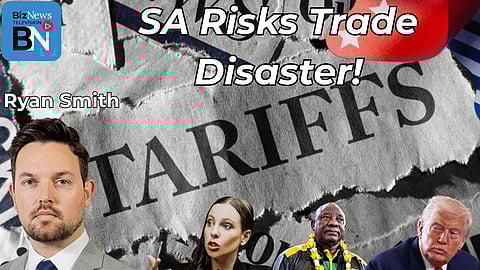
Following the resignation of Emma Powell, Ryan Smith has been announced as the Democratic Alliance's spokesperson on International Relations and Cooperation. In his first interview since his appointment, Smith speaks to BizNews about the chances of South Africa cutting a last-minute deal with the United States to avert the 30% export tariffs due to come into effect on Friday. He reacts to US President Donald Trump’s latest utterances in which he reiterated that he has had a “lot of problems with South Africa” and once again cited “some very bad policies”. Describing what it would take to reset the US-SA relationship, Smith urges non-alliance and a foreign policy that is “no longer the ambit of political whims”. On the resignation of Powell - who cited harassment, threats and intimidation - he says “it became far too heavy a personal toll for her”. As for what he now faces, Smith says: “… there are allegations across every government department of collusion, political interference, of corruption, and when you take your oath of office and you take a seat as a Member of Parliament in South Africa, certainly on the DA's benches, you are well aware that you're going up against all of this and that it can get very, very ugly”..Sign up for your early morning brew of the BizNews Insider to keep you up to speed with the content that matters. The newsletter will land in your inbox at 5:30am weekdays. Register here.Support South Africa’s bastion of independent journalism, offering balanced insights on investments, business, and the political economy, by joining BizNews Premium. Register here.If you prefer WhatsApp for updates, sign up to the BizNews channel here.The auditorium doors will open for BNIC#2 on 10 September 2025 in Hermanus. For more information and tickets, click here..Watch here.Listen here.Edited transcript of the interview.Chris Steyn (00:02.073)Following the resignation of Emma Powell, Ryan Smith has been appointed as the Democratic Alliance's spokesperson on International Relations and Cooperation. He is with us now. Welcome, Ryan. Ryan Smith (00:16.526)Good morning Chris, thanks very much for having me. Chris Steyn (00:19.897)Please take us through your qualifications and your background, your rise in the party. How did you end up in this portfolio? Ryan Smith (00:27.384)You wanna see if I'm fit for purpose. My career actually began in international affairs before I got involved in politics. So I completed my undergraduate degree, my Bachelor of Arts in International Relations at Wits University. I had a double major along with French and I studied Italian and Portuguese as a minor. So very much focused on the international space. Ryan Smith (00:52.154)But I specialised in my Honours degree in my postgraduate in International Communication. So I trained as a simultaneous interpreter, working primarily in the diplomatic space, and then went on to complete my traineeship at the European Parliament in Brussels, Belgium, where I spent quite a few months after my postgraduate degree. So that's how I started out. I obviously returned to South Africa after that. I wanted to enter the diplomacy space. you know, get a job at DIRCO in any capacity. But I found it very, very difficult with the government bureaucracy and the quota system. And it was very difficult for me to gain access to DIRCO as a potential employee. And I think many people who studied International Relations have had similar experiences. And one of my former classmates actually was working for the DA at Parliament. And he said, well, look, you can still work in international affairs if you just take it from a different angle. So I went the political route. I did have a brief stint in the private sector for about two years, but I think I really ingratiated myself in politics from about 2015 onwards. And I served as the Head of Media and Research for the Western Cape legislature for the DA caucus there when Helen Zille was the Premier for about five years. And then John Steenhuisen asked me to come and manage his office. So I took up the position as Chief of Staff in his office as the Federal Lead of the party. And I was there from 2020 until last year where I was elected as a Member of Parliament and subsequently onto the Foreign Affairs Committee. Chris Steyn (02:24.399)Okay, then you qualify to answer the next question. Do you think there is still a chance that South Africa could cut a last minute deal with the United States to avert the 30% export tariffs due to coming to effect on Friday? Ryan Smith (02:44.642)Yes, absolutely. It's look, I'll preface the discussion by saying that it is quite concerning that South Africa has left it really to the last minute, that there's been no proactive approach to the trade negotiations with the United States under Donald Trump. And it really shows a lack of proactivity, I think, on South Africa's economic diplomacy’s part because the art of diplomacy is to preempt political shifts with your trading partners and to really be proactive in predicting what might come of that. We know that Trump was approaching trade relations with the US First, America First position, and South Africa should have been prepared for that. And I think we really were caught by surprise on a matter where we really should have been prepared. I would say there's definitely a huge amount of negligence on the ANC's part, certainly in the Foreign Affairs and Trade portfolio. That being said, I know that the current trade relations are subject to a non-disclosure agreement, so we don't have any sight of what's happening behind the scenes. But we saw the communique that came out from Minister Parks Tau yesterday saying that discussions are still underway, that the deal is still being concocted. But it really is a race against time because remember, we're not just looking for a deal for South Africa, but we're competing with similar countries that have similar products that they would like to export to the United States at the same time. And if we can't cut a good enough deal, we can actually be undercut by many of the other nations who are competing under similar sets of circumstances. So in short, I do think that we can reach a deal. It's unfortunate that it's taken us so long to be more proactive and to come to a decisive decision. And South Africa is lucky in that we have several industries that are actually protected or ring-fenced outside of a tariff sort of area, things like natural mineral, raw minerals, for example, that we export to the United States. It's not all doom and gloom, but really, you know, for the interest of South Africa economically, it is absolutely crucial that we get a deal as soon as possible, that we avoid a tariff. I mean, best case scenario, I think in this in this case would be just to get a 10% tariff. We'd be lucky if we get no tariff at all. Ryan Smith (05:10.402)But ultimately, South Africa needs to really negotiate these as a matter of urgency to make sure that we get the best possible deal, not just for our government, but for the whole country. Chris Steyn (05:20.943)Now in his latest utterance, US President Donald Trump was not very optimistic about his relationship with us. He said he still has had, or he has had a lot of problems with South Africa. And once again, he cited some very bad policies. What will it take to please him? Ryan Smith (05:45.354)Again, you know, it's a difficult scenario to manage. And I really think that in this discussion between South Africa and the United States, the facts have gotten lost. There's been a lot of decision making and a lot of discussions taking place based off of hearsay, based off of rumours. So I really think that the discussion first and foremost needs to be rooted back into something that is factual. South Africa does have a number of problematic domestic policies. You know that policies such as BEE are deterrents, for example, to foreign direct investment. We know that Employment Equity is actually harming the economy. And those are issues that we need to take up here as political parties. It's not customary for a foreign actor really to interfere in the domestic policies of another country, specifically when it comes as a direct consequence of trade negotiations. It's a, it's certainly a new, it's a new environment, a new territory that we have to, that we have to manage. But that being said, South Africa obviously needs the United States and navigating this new norm and navigating this, this tremendous gray area, I think that we find ourselves in is really where diplomacy is, is most crucial. That's really what the art of diplomacy is. It's not negotiating terms on behalf of your country in the world that you want, is negotiating terms for your country in the world that you find yourself in. And I think this gray area that we've now been presented with, and again, something that we should have predicted or be more proactive in negotiating from the start, is something that we have to urgently grapple with as South Africa. We do need to look at our domestic policies. I don't think it requires a threat from one of our largest trading partners for us to actually say, well, is this policy working or is it not? And I think that South Africa needs to really be honest with itself. And certainly the ANC needs to be honest with policies that sound very good on paper, but in practice and certainly in terms of their outcome have been far more detrimental to South Africa and the economy than what the ANC seems to believe. So it is a difficult path that we need to traverse. It really is where the art of diplomacy comes really into play. Ryan Smith (08:03.35)And I think it's a very good test of South Africa's diplomatic capability because we've really rested on our laurels and been far too reliant on the favourable treatment towards South Africa over the last few years. And that goodwill is now running out. And I think that South Africa, certainly in foreign affairs and from the Presidency, needs to take that very seriously. Chris Steyn (08:23.971)What would you describe as South Africa's biggest foreign policy priorities right now? Ryan Smith (08:30.082)Well, South Africa needs to determine what its national interest is. This is the really big question, I think, hanging over South Africa's foreign policy stance at the moment. And what we've seen is up until this point, the ANC has not really enacted a foreign policy that has been rooted, in the Constitution and, B, that has acted in the best interests of South Africa. And we speak about the national interest, but this has never actually been defined. So how do you set parameters or put boundaries as to what South Africa should or shouldn't do based on what's good or not good for the country. And so in the absence of that definition, foreign policy is enacted and certainly has been enacted on a very short term political sort of tactical basis as opposed to part of a broader long term comprehensive strategy that takes into account what South Africa needs and how we can best leverage it by means of the international system. And so therein, I think, lies the question, and this is really what South Africa now needs to flesh out, certainly in the Government of National Unity environment, where we no longer have a sole party that is dictating foreign policy. It should be a plurality of voices, actually, that come to the table. And foreign policy is no longer the ambit of political whims. It should be what is best for the country, what promotes the principles in our constitution. And there needs to be a balance found, I think, between those two things. And I mean, just to give you a brief sort of idea of what I think we need to start with, I mean, we need to determine the national interest. We need to take a look at South Africa as a middle power with a fairly weak economy. We don't really have much political clout because we don't have an economy with which we can, you know, leverage trade deals with which we can make certain statements on the international stage. And with that then comes the main issue of South Africa, is unemployment. The main thing we need to be leveraging from foreign policy is actually trade. So the focus needs to be shifted to economic diplomacy. And we need to determine what trade we need, where we can get it from, and how best to leverage it using the global system. And we also need to use international best practice models. I've been working on the G20 on behalf of the DA. And we've said, I wrote a letter to President Ramaphosa, and I said….Read more:.BN Briefing: Pretoria Girls scandal deepens; Safair strike; Gupta mansion; Bitcoin goes corporate.Ryan Smith (10:52.344)…there are countries that are G20 members that have very similar socioeconomic circumstances to South Africa, but that are seeing record growth rates economically that are really increasing trade, that are investing in crucial industry that's really leading to social upliftment, which is exactly what South Africa needs. We need to look at what policies they're adopting and maybe look at replicating them or adapting them to a South African system so that we enjoy similar rates of growth in the developing world because South Africa really is being left behind. And I think you can use India as a very good example. India is not worried about interfering diplomatically in what's happening in the world. They're more focused on who can we trade with, to what extent, and how are we leveraging that to maximum capacity. And I think India really embodies the non-aligned movement that South Africa seems to love to preach about, but very rarely actually practices on. We should be non-aligned because it's not in our economic interest internationally to make bold diplomatic or take bold diplomatic action that get a lot of flak and pushback further down the line. We need to remove barriers to trade such as BEE and Employment Equity, for example. We need to then root foreign policy in the Constitution while being pragmatic about trade, as I mentioned. And I think we also need to ensure that South Africa gets bang for its buck in terms of international institutions. We are one of very few African member states that actually pays its membership fees on time to institutions such as the African Union, to the United Nations. And yet we tend to cower away when it comes to using those platforms to push for real change, specifically in our region. And I think just to end off on the national interest topic, we need to look at South Africa's national security as well. If we turn a blind eye to the backslide of democracy in neighbouring countries such as Zimbabwe or such as Mozambique, for example, that has a knock on effect in South Africa further down the line. And it affects all number of departments and governments, sort of ministries in South Africa, ranging from Defence to Home Affairs to, you know, it worsens poverty, it crowds out a lot of service delivery… Ryan Smith (13:14.552)…that is already under strain for South African citizens, not just among many of the refugees who fleeing into South Africa as a result of instability in the region. And so South Africa really should, I think, position itself first as a regional mediator and a regional power, certainly for national security and economic reasons before we start venturing further out. Chris Steyn (13:34.671)As a matter of interest, have you had a reply from President Ramaphosa to your letter? Ryan Smith (13:42.21)Yes, well, you know, we get the reply. We don't get a reply from the President himself. I think we get an acknowledgement of receipt, which is fairly customary, but we will get a response via the media, which comes normally from the President's spokesperson, which is Vincent. I can't recall his name at the moment. And it's the same sort of arrogant approach of the President will decide what South Africa's foreign policy is and you have no say in it. The difference in the Government of National Unity is that the president is not just elected by the ANC. He serves at the pleasure of various parties that elected him into power. I cast my vote, for example, for him to be the President of the country. So it's really politically and intellectually disingenuous for the president's spokesperson to turn around and still act as if the ANC governs with a clear majority when it really does not. So that's as far as we get from the president in terms of a response. We're hoping that Minister Lamola be more favourable in his interaction with the DA. There needs to be far more collaboration. But as I said, that requires abandoning party political interests in the foreign policy space and looking at what's best for South Africa first. Chris Steyn (14:54.317)Now your predecessor, Emma Powell, cited harassment, threats and intimidation as influencing her decision to resign. You must have thought twice about stepping into her shoes, Ryan. Ryan Smith (15:09.41)Yes, look, any member of parliament, especially in a country like South Africa, where regardless of the portfolio you're on, there's rampant corruption, are criminal syndicates, we know by virtue of recent allegations laid against the former Police Minister that there are allegations across every government department of collusion, political interference, of corruption, and when you take your oath of office and you take a seat as a Member of Parliament in South Africa, certainly on the DA's benches, you are well aware that you're going up against all of this and that it can get very, very ugly. A number of our MPs, certainly through the State Capture years under former president Jacob Zuma, suffered similar cases of harassment and threats and intimidation. It's really an occupational hazard, I would say, when you become a Member of Parliament, certainly on the opposition benches. It's not something that is uncommon. I think in Emma's case, it became far too heavy a personal toll for her. She was doing absolutely excellent work on the portfolio, but there's only so much that she can take. There's a reason why politicians need to move between portfolios or chart a different path for themselves. So no, it's not uncommon for you to be faced with that when you take up a position like this. But you have to, as they say, have a thick skin and a strong spine as a politician, and you have to have very, very strong principles in order to proceed. And I certainly hope to follow in Emma's footsteps. She's been a wonderful colleague and mentor over the years. I've known her for a number of years, and we've worked very closely together. And we'll continue to carry that baton forward. Chris Steyn (16:56.131)Thank you. That was Ryan Smith, the Democratic Alliance's new spokesperson on International Relations and Cooperation speaking to BizNews. And I'm Chris Steyn. Thank you, Ryan. Ryan Smith (17:07.31)Thank very much.