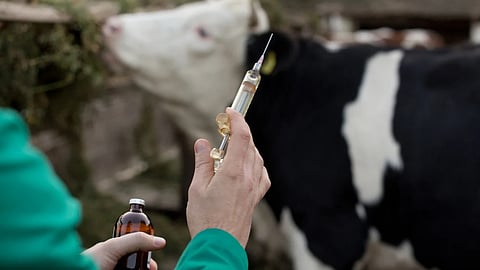
As the world grows more uncertain, clarity matters more than ever. BNC#8 brings together some of the smartest and most experienced minds to help you cut through the noise and navigate the turbulence with greater confidence. Tickets are selling out fast, with only 40 left. Don’t waste time, book your place at BNC#8 by clicking here or on the image below..Key topics:Private veterinarians now allowed to vaccinate against FMD.Shift from state-only rollout to a scalable hybrid model.Aim to control 935 outbreaks and restore FMD-free status..Sign up for your early morning brew of the BizNews Insider to keep you up to speed with the content that matters. The newsletter will land in your inbox every morning on weekdays. Register here.Support South Africa's bastion of independent journalism, offering balanced insights on investments, business, and the political economy, by joining BizNews Premium. Register here.If you prefer WhatsApp for updates, sign up to the BizNews channel here..By Andrew Morphew.On Tuesday morning, the first trucks departed carrying 50,000 FMD vaccine doses from the Allerton Provincial Veterinary Laboratory. The Milk Producers Organisation (MPO) delivered them to private veterinary practices across the Harry Gwala District Municipality. By the time you read this, those doses will have been injected into cattle. That is not a press release. That is the strategy is working.South Africa now has 935 confirmed foot-and-mouth disease outbreaks formally reported to the World Organisation for Animal Health. Every province is affected. The national herd, some 14 million cattle, requires approximately 28 million doses to complete two rounds of vaccination. What changed, quietly, was a decision to act on it.THE STRUCTURAL CONSTRAINTFor the duration of South Africa's FMD crisis, vaccination remained the exclusive domain of the state. Under the Animal Diseases Act, FMD is classified as a controlled disease. The department procured the vaccines. State veterinarians administered them. The regulatory logic was grounded in genuine biosecurity requirements - traceability, compliance, and the long-term goal of regaining FMD-free status with vaccination, lost in 2019..Read more:.Steenhuisen has the FMD blueprint, he just refuses to follow it — Andrew Morphew .But logic does not vaccinate cattle. Capacity does.State veterinary teams, however committed, are finite. Against 935 open outbreaks across nine provinces, a centralised execution model was always going to struggle with the arithmetic of scale.THE DECISIONDuring the parliamentary debate on the State of the Nation Address, Minister Steenhuisen made an announcement that passed without significant fanfare. In a briefing otherwise dominated by vaccine shipment figures and provincial deployment plans, he noted almost inpassing:"In terms of the Animal Diseases Act, private veterinarians can register to administer vaccines as part of the rollout strategy."No ideological framing. No announcement that the model was being recalibrated.This was not administrative housekeeping. It was a decision to expand the battlefield.It required regulatory confidence - the judgement that expanding execution would strengthen, not weaken the integrity of the response. Oversight remains fully with the state. Standards, strain specifications, allocation priorities, and reporting requirements do not change. What Changes is who holds the needle.WHY IT MATTERSOversight belongs to the state. Execution must be scalable. This decision begins to align those roles.International experience with large-scale FMD control shows that the most effective campaigns separate regulatory authority from field execution. Government sets the standards and manages the data. The private veterinary sector provides the reach. This moves South Africa in that direction - not as a concession, but as a structural recalibration that increases scale without weakening compliance.The shift is already translating into movement. Private veterinary practices in KwaZulu-Natal received their first consignment yesterday. Thirty-four private veterinarians vaccinated roughly 50,000 cattle in a single day - demonstrating the scale that becomes possible when execution capacity expands.Major outbreaks are rarely turned into declarations alone. They are turned when systems evolve.This was the moment the response moved from containment-by-control to containment-by- scale. If the trajectory of this outbreak bends in the coming months, this decision will mark the point at which it began to do so.WHAT STILL NEEDS TO WORKThis is progress. It is not a resolution.The hybrid model is still maturing. Procurement remains centralised, and supply constraints have not disappeared. Distribution logistics - getting the right vaccines to the right areas at the right time - remain a live operational challenge. The national vaccination targets are now more achievable than they were. They are not yet achieved.The principle that private capacity should be mobilised, not bypassed, is now embedded in the rollout. Whether it is sustained and expanded - into procurement, into pre-emptive vaccination, into a more integrated industry partnership - will determine whether this becomes a structural shift or a tactical accommodation.There is more reform available. The direction being taken encourages it.THE RECOGNITION IT DID NOT RECEIVEThe months preceding this shift were defined by regulatory caution, import delays, and rising case numbers. That context should not be ignored. But neither should the significance of what has now changed.The private veterinarian registration scheme is not a headline. It has not been treated as one.What it is, in practical terms, is one of the most significant structural shifts in the management of this outbreak. It multiplies field capacity. It distributes professional accountability across a broader network. It does so without dismantling any of the regulatory architecture that compliance requires.Leadership is measured by knowing when to shift the line. By opening the rollout to registered private veterinarians, the Minister shifted the system from defending a structure to defending the herd. The infection does not respond to declarations. It responds to vaccines in cattle.Yesterday, those vaccines were moving. That deserves recognition - and it deserves to be built on..Read more:.FMD crisis: How did we get to this point? — Terence Corrigan.South Africa's path back to FMD-free status will be measured in years. Direction changes are measured in decisions. This was one of them.The most consequential victories are rarely declared. They are authorised.